CompareCompare9 min read
Shopify vs Lightspeed for Retail and Online Selling
Lightspeed starts from the till and Shopify starts from the online store. Here is what each costs for a shop with a website, where each is stronger, and how to choose.
Key takeaways
- Lightspeed starts from the till. Its US Retail plans cost $89, $149 or $289 a month and each includes one register and a built-in online store. Shopify starts from the online store and adds POS Pro for $89 a month per location.
- For one shop plus a website, the software costs are close: Shopify Basic with POS Pro is $108 a month on yearly billing, against $89 for Lightspeed Retail Basic billed monthly.
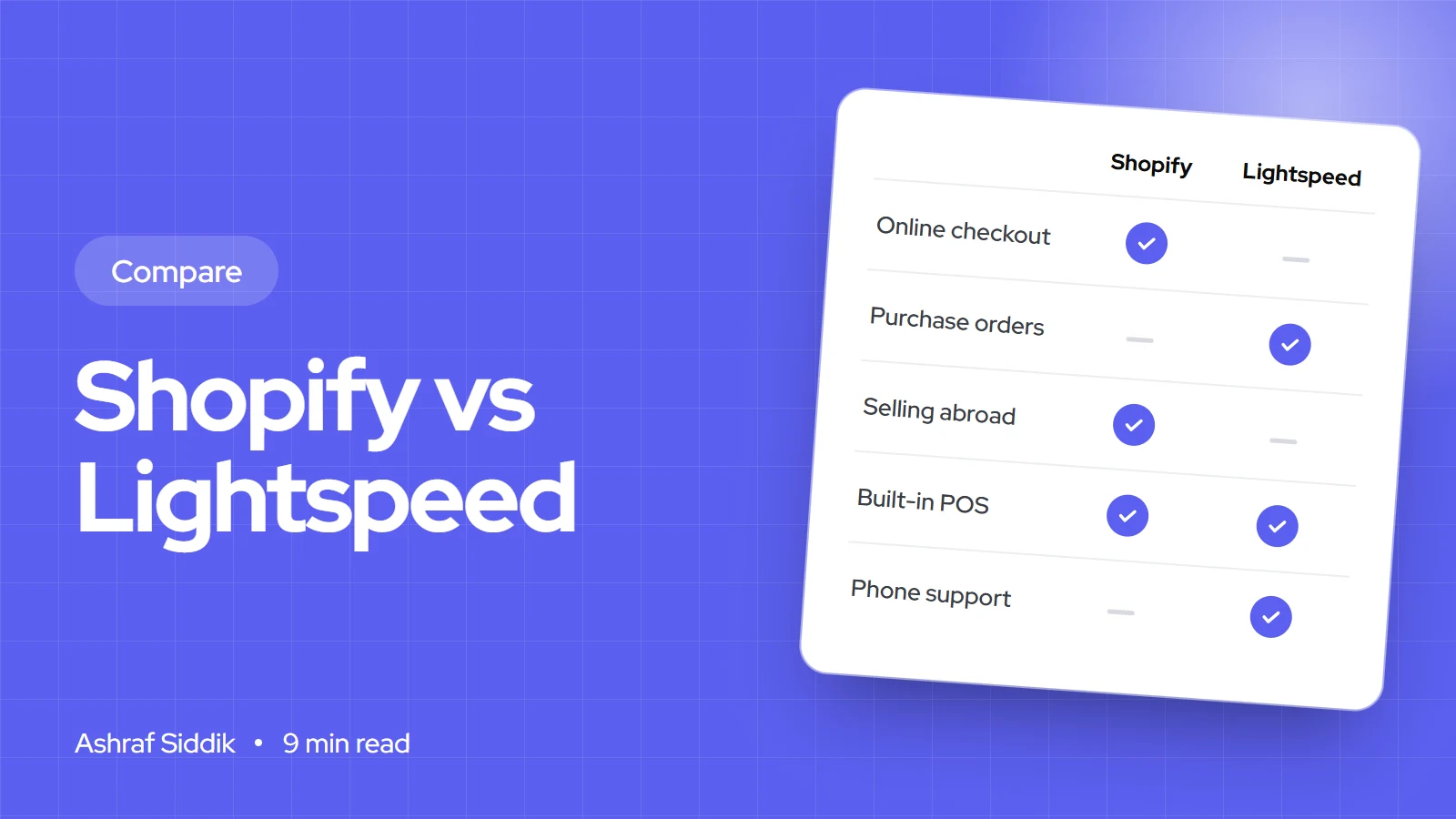
- Lightspeed is stronger on retail stock work: purchase orders, landed costs and ordering from brands through NuORDER are on every Retail plan. Shopify is stronger online: checkout, apps and selling in several countries.
- In the Netherlands, Lightspeed's standalone eCom plans run from €68 to €259 a month and cap product variants by plan, from 250 to 15,000.
- Who it is for
- Retailers with a shop and a website
- Time needed
- 11 minutes to read, an hour to compare quotes
- What you need
- Your counter and online sales split, locations and supplier count
Shopify vs Lightspeed is a choice between a platform that began as an online store and one that began as a till. I'm a Shopify developer, so that's my bias. I also know retailers who are better off on Lightspeed, usually shops where in-store sales and stock control matter far more than the website. This page is about telling which kind of business you are.
Prices below come from Lightspeed's US and Dutch pricing pages and Shopify's pricing pages, checked on 7 November 2026. Lightspeed shows annual pricing as a toggle ("save up to 18%") without the amounts, and doesn't publish prices for extra registers or locations, so I only quote what it states.
The short answer
| Your situation | Better fit | Why |
|---|---|---|
| A shop where most sales happen at the counter | Lightspeed | Retail stock tools, purchasing and 24/7 phone support on every plan |
| An online brand that also has a shop or pop-ups | Shopify | The online store comes first, and POS shares the same stock |
| You buy from many brands and reorder often | Lightspeed | Purchase orders, landed costs and NuORDER catalog built in |
| Selling online in several countries | Shopify | Shopify Markets handles currencies, languages and domains |
| A large online catalog | Shopify | Plans aren't priced by number of variants |
| A Dutch or Belgian retailer who wants one local supplier for till and webshop | Lightspeed | Local Dutch plans and pricing, and eCom with its roots in the Netherlands |
Shopify vs Lightspeed Retail: two different starting points
Lightspeed Retail (its X-Series) is a point of sale system first. Inventory, purchasing, registers and staff come first, and every plan now includes a Lightspeed online store. Lightspeed also sells eCom on its own in some countries, and its eCom product grew out of a Dutch webshop platform, which is why it is so common in the Netherlands and Belgium.
Shopify is an online store first, with Shopify POS added on top. Every Shopify plan includes POS, and POS Pro adds the tools a busy shop needs. One product list, one stock count and one customer list cover both.
That history shows. Lightspeed's retail stock tools are deeper out of the box. Shopify's online store, checkout and app ecosystem are deeper. Most of the decision comes down to where your revenue is today, and where you want it in three years.
Shopify vs Lightspeed pricing
Lightspeed's US Retail plans, each with one register:
| Lightspeed Retail (US) | Per month | Online store | AI Doc Import |
|---|---|---|---|
| Basic | $89 | Included, Basic tier | Add-on |
| Core | $149 | Included | Add-on |
| Plus | $289 | Included | Included |
All three include inventory management, Lightspeed Wholesale, NuORDER catalog, purchase orders, landed costs, loyalty in store and online, advanced reports, API access, custom user roles and 24/7 chat and phone support. Extra registers and locations cost more, but the page doesn't say how much, and businesses with several locations are pointed to a custom plan. Lightspeed also notes that prices can vary and extra service fees may apply depending on your business and industry.
| Shopify (US) | Billed monthly | Billed yearly | POS Pro, per location |
|---|---|---|---|
| Basic | $25 a month | $19 a month | $89 a month, billed yearly |
| Grow | $65 a month | $49 a month | $89 a month, billed yearly |
| Advanced | $399 a month | $299 a month | $89 a month, billed yearly |
POS Pro adds unlimited staff logins, staff roles and permissions, customer profiles, loyalty insights, returns and exchanges at any location, inventory management and retail reports. Shopify adds a fee of 2%, 1% or 0.6% on Basic, Grow or Advanced if you use a payment provider other than Shopify Payments.
Lightspeed eCom pricing in the Netherlands
On its Dutch site, Lightspeed sells Retail plans at €99 (Basis), €149 (Essentieel) and €229 (Plus) a month, with built-in eCom at the Venture tier on Basis and the Business tier on the other two. It also sells eCom on its own:
| Lightspeed eCom (NL) | Per month | Product variants | Users | Languages |
|---|---|---|---|---|
| Essential | €68 | 250 | 1 | 1 |
| Advanced | €120 | 5,000 | 3 | 3 |
| Professional | €259 | 15,000 | Unlimited | 7 |
| Enterprise | On quote | Up to 65,000 products, 100 variants each | Not stated | Not stated |
Professional adds discount rules, product bundles, appointment booking and B2B. The Dutch pages don't say whether prices include BTW, and they don't show annual prices, extra register prices or payment rates. Ask for these in writing before you sign.
The variant caps are the number I would look at first. A clothing shop with 60 styles in 5 sizes and 2 colors already has 600 variants, past the Essential limit. Shopify's plans aren't priced by variant count, and a single product can have up to 2,048 variants.
What a shop plus website costs: a worked example
Monthly software cost for one US shop with an online store
- Shopify Basic + POS Pro$108$19 plan, $89 POS Pro, both billed yearly.
- Shopify Grow + POS Pro$138$49 plan, $89 POS Pro, lower online card rate.
- Lightspeed Retail Basic$89One register, Basic online store, billed monthly.
- Lightspeed Retail Core$149One register, fuller online store, billed monthly.
On software, the two are close for a single shop. Card fees matter more. Lightspeed Payments charges 1.5% on card-present payments on all US Retail plans, so a shop taking $30,000 a month at the counter pays $450. Lightspeed doesn't publish its online card rate, and Shopify's POS pricing page doesn't list its in-person rates, so ask both for a written quote based on your own counter and online sales split. Online, the standard US rates Shopify has quoted are 2.9% + 30¢ on Basic and 2.7% + 30¢ on Grow.
Some retailers run Lightspeed in the shop and Shopify online, linked by an integration. It works, but you pay for both and keep two systems in sync, so I only suggest it when the shop team is deeply attached to Lightspeed.
In the shop: POS and inventory
This is Lightspeed's home ground. Every Retail plan includes purchase orders, PO sync, landed costs (so your margins include freight and duties), NuORDER for ordering from brands, Lightspeed Wholesale, a mobile scanner app and advanced reports. For a multi-brand boutique, bike shop or homeware store that reorders from dozens of suppliers, that saves real time.
Shopify POS covers the counter well: one stock count across store and website, customer profiles, returns and exchanges at any location, and staff roles on POS Pro. For deeper purchasing, Shopify uses apps. If your buyers live in purchase orders and supplier catalogs, try both with your real workflow before deciding.
Shopify vs Lightspeed eCommerce: the online store
Online, Shopify has the stronger hand. Shop Pay saves shoppers' details across every Shopify store, so returning customers can pay in a couple of taps. The Shopify App Store and the pool of Shopify themes and developers are far larger. And Shopify's plans aren't capped by product variants or languages.
Lightspeed's online store has the advantage of being part of the till system, with the same products, stock and loyalty. Its Dutch eCom plans add blogs, filters and a theme editor on Advanced, and B2B, bundles and appointment booking on Professional. It is a capable webshop for a retailer. It is a weaker platform if the website is where you want most of your growth to come from. That is where conversion work on Shopify tends to pay off fastest.
Selling in other countries
Shopify Markets lets one store show local currencies, prices, languages and domains per country. Lightspeed's Dutch eCom plans include 1, 3 or 7 languages depending on the tier.
- United States. Lightspeed Payments charges 1.5% in person on all Retail plans. Shopify calculates sales tax for you online.
- United Kingdom. Both have UK sites. Shopify's UK online rates are 2% + 25p on Basic and 1.7% + 25p on Grow, with plans at £19 and £49 a month billed yearly. Check Royal Mail label support on either.
- Netherlands and Belgium. Lightspeed is a local name here, with its own Dutch site, plans and pricing. Shoppers expect iDEAL and Bancontact, and you need BTW handled correctly; confirm both platforms cover them with your payment provider. My Netherlands page covers the Shopify setup.
- Australia. Lightspeed has an Australian site. Check Afterpay, GST settings and Australia Post labels on whichever you choose.
When to choose which
Choose Lightspeed if most of your revenue comes through the till, you buy from many brands and reorder often, and you want purchasing, landed costs and 24/7 phone support in one subscription.
Choose Shopify if the website is or will be your main channel, you sell abroad, you have a large online catalog, or you want the widest choice of apps and developers.
Signs you have outgrown Lightspeed's webshop:
- You keep hitting variant, user or language limits on your eCom plan.
- Online sales are growing faster than the shop, and the website needs more than a retail add-on.
- You want apps or checkout features that Lightspeed doesn't offer.
- You want to sell in several countries with local prices and domains.
How to decide in three questions
Lightspeed or Shopify?
- 1
Do more than half your sales happen at the counter?
Yes: lean towards LightspeedNo: lean towards Shopify, then next question
- 2
Is purchasing from many suppliers a daily job for your team?
Yes: Lightspeed, or Shopify with a purchasing app after a trialNo: next question
- 3
Do you want the website to drive most of your growth, or sell abroad?
Yes: ShopifyNo: Lightspeed will serve a shop-first business well
To check which platform another retailer uses, try the platform checker.
Moving from Lightspeed to Shopify
- Export products and stock. Export products, variants, barcodes and stock per location, then map them to Shopify's product CSV and inventory locations.
- Export customers and loyalty. Customer lists move by CSV. Decide how to carry loyalty balances across, usually with a loyalty app.
- Set up POS. Add POS Pro for each location, set staff roles, and test card readers and receipt printers before switching over.
- Rebuild the webshop and redirect URLs. Map every old product and category URL to its new Shopify URL and add the redirects.
- Plan the cut-over. Switch on a quiet day, do a stock count the night before, and keep the old system read-only for reference.
- Test, launch, then watch. Run real sales in the shop and online, check redirects and watch Search Console for a few weeks.
If you'd like help, my Shopify development work covers migrations with a fixed quote, and store builds start from $300. Start with a free review and I'll tell you honestly whether the move would pay off for your shop.
Free tools
Check your own store
Free, no sign-up. Each one runs a part of this guide for you.
Frequently asked questions
Is Lightspeed cheaper than Shopify?
For one shop with a website, the software is close: Lightspeed Retail Basic is $89 a month billed monthly, and Shopify Basic with POS Pro is $108 a month billed yearly. Extra locations and card fees usually decide it, and Lightspeed doesn't publish its extra-location prices.
Does Lightspeed include an online store?
Yes. All US Lightspeed Retail plans include built-in Lightspeed eCommerce, at a Basic tier on the Basic plan. In the Netherlands, Lightspeed also sells eCom on its own from €68 a month.
What does Lightspeed charge for card payments?
Lightspeed Payments charges 1.5% on card-present payments on all US Retail plans. Its pricing page doesn't state an online card rate, and the Dutch page doesn't list payment rates, so ask for them in writing.
Is Lightspeed or Shopify better for a retail shop?
Lightspeed is often better when most sales happen in store and you buy from many suppliers, because purchase orders, landed costs and NuORDER are built in. Shopify is better when the website is, or will be, your main channel.
Can I use Lightspeed in store and Shopify online?
Yes, through an integration. It works, but you pay for both systems and keep them in sync, so I only recommend it when the shop team is committed to Lightspeed.
Does Lightspeed eCom limit products?
On the Dutch eCom plans, yes: 250 variants on Essential, 5,000 on Advanced and 15,000 on Professional, with Enterprise up to 65,000 products. Shopify's plans aren't priced by variant count.
Sources
- Lightspeed Retail pricing, Lightspeed
- Lightspeed eCom prijzen, Lightspeed
- Lightspeed Retail prijzen, Lightspeed
- Shopify POS pricing, Shopify
- Shopify pricing, Shopify
Related services and work

I'm a Shopify developer and CRO specialist. I have built and improved Shopify stores since 2018, completed more than 1,000 projects, and hold a 4.96 average rating across 719 client reviews.
More guides
-
Why Shopify Stores Lose Sales on Mobile: A Practical CRO Checklist
Mobile visitors decide fast, with one thumb and plenty of distractions. Here is how to find the leaks on a Shopify store and fix them in the right order.
-
Shopify CRO Audit Checklist for DTC Brands
The checklist I use to audit DTC Shopify stores, from checking that the data can be trusted to deciding which fixes to ship first.
-
When to Build a Custom Shopify App Instead of Adding Another Subscription
Another subscription is the quickest fix, until you are paying for five apps that still don't match how your business works. Here is how to decide.
-
How to Find Out What Theme a Shopify Store Uses
Every Shopify store names its theme in the page code. Here is where to look, how to read what you find, and what it means for your own theme choice.
-
How to See What Apps a Shopify Store Uses
Apps leave traces in a store's page code: scripts from their own servers, app embed folders and pixel settings. Here is how to read them, and what to do with the list.
-
How to Name a Shopify Store (and Check the Name Is Free)
A store name has to be easy to say, free as a domain and a handle, and clear of other brands. Here is the process I use with clients, and what Shopify lets you change later.