Cost guideCost7 min read
How Much Does Shopify Plus Cost, Really?
Plus starts at $2,300 a month, but the term, your currency and an unpublished revenue fee change what you sign for. Here is the full cost, and the sum that tells you whether it pays off.
Key takeaways
- Shopify Plus costs $2,300 a month on a 3-year term or $2,500 a month on a 1-year term in the US, as listed in Shopify's help center on 7 November 2026. That is $27,600 or $30,000 a year.
- Higher-volume stores may also pay a variable platform fee based on revenue and business model. Shopify doesn't publish the rate or the threshold, so get it in writing before you sign.
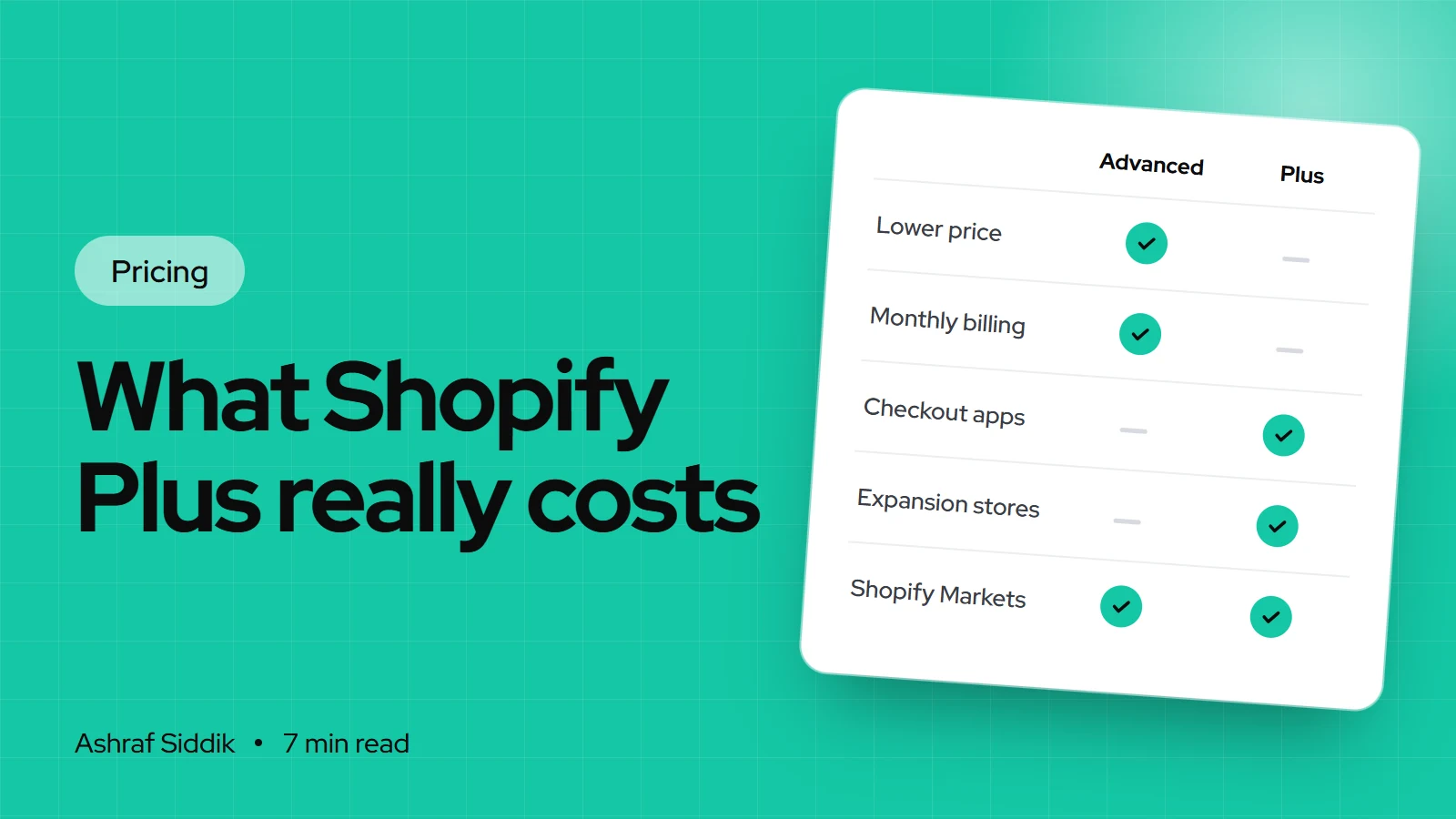
- Plus costs about $24,000 a year more than Advanced billed yearly. Lower fees rarely cover that gap. Features have to.
- A simple test: at a 40% gross margin, Plus needs to bring in about $5,000 a month of extra sales just to break even against Advanced.
- Who it is for
- Brands on Advanced weighing an upgrade
- Time needed
- 8 minutes to read
- What you need
- Your monthly sales, gross margin and the features you want
Shopify Plus has a list price, but the number you actually sign for depends on three things: the length of your contract, the currency you're billed in and, for larger stores, a revenue-based fee that Shopify doesn't publish. I've helped brands move onto Plus and talked others out of it, and the conversation always starts with the same sum: what Plus costs per year against what it has to earn.
Prices below come from Shopify's pricing page and its Shopify Plus help center article, as checked on 7 November 2026. Shopify notes that Plus pricing is subject to change, so confirm your quote with Shopify's Plus team. For the feature-by-feature view, read my Shopify vs Shopify Plus comparison.
The short answer
| Cost | Amount | Notes |
|---|---|---|
| 3-year term, US | $2,300 a month | The lowest listed Plus price |
| 1-year term, US | $2,500 a month | $2,400 a year more than 3 years |
| Variable platform fee | Not published | Based on revenue and business model |
| Fee with other providers | 0.2% | Against 0.6% on Advanced |
| Build or move to Plus | Fixed quote | Depends on what you want Plus for |
Plus prices by country and term
Shopify bills Plus in local currency in several countries. These are the monthly prices its help center listed:
| Billing currency | 1-year term | 3-year term |
|---|---|---|
| US and most other countries | $2,500 | $2,300 |
| UK | £1,950 | £1,800 |
| EU and EEA | €2,250 | €2,100 |
| Australia | A$4,000 | A$3,700 |
| Canada | C$3,650 | C$3,400 |
Shopify's pricing FAQ says that on a 1-year or 3-year Plus subscription, you can cancel when the term commitment expires. In practice that means you are committing to 12 or 36 months of payments. A 3-year term saves $200 a month in the US, but only choose it if you're confident you'll still want Plus in year three.
The variable platform fee
Shopify's help center says higher-volume businesses "might" pay a variable platform fee "based on your revenue and business model", and that it differs for B2B and direct-to-consumer sales. It gives no rate and no revenue level where the fee starts.
You'll find percentages quoted on agency blogs. I don't repeat them, because they are estimates and your contract may differ. What I tell clients is this: if your revenue is high enough that the fee could apply, ask Shopify's Plus team for your exact terms in writing, and put that number into the break-even sum below before you sign.
What Plus costs per year, against Advanced
| Plan | Per month | Per year | Gap to Advanced |
|---|---|---|---|
| Advanced, billed yearly | $299 | $3,588 | – |
| Plus, 3-year term | $2,300 | $27,600 | $24,012 a year |
| Plus, 1-year term | $2,500 | $30,000 | $26,412 a year |
These figures leave out the variable platform fee, because it isn't published. Any fee you're quoted adds to the gap.
What the price includes
Shopify's help center lists these as part of Plus. Each one is worth a price only if you would use it:
- 9 expansion stores for other countries, brands or locations. Each live expansion store needs its own theme license.
- Up to 200 locations and unlimited staff accounts at no added cost, against 10 locations and 15 staff on Advanced.
- Advanced B2B: unlimited catalogs, catalogs assigned directly to companies, deposits, partial payments and payment requests per fulfillment.
- Checkout customization through the Checkout Branding API and checkout extensions, with separate B2B and direct-to-consumer checkout flows.
- Shopify Functions in custom apps, so a developer can build your own discount, shipping and payment rules.
- Launchpad for scheduled sales and product drops, and priority 24/7 phone and chat support.
- Higher limits, such as up to 20 million URL redirects against 100,000 on other plans.
Costs on top of the Plus price
- Building what you bought Plus for. Checkout extensions and custom Functions need a developer. My custom app work starts from $800, and every Plus project gets a fixed quote once the scope is clear.
- Theme licenses for expansion stores. Each live expansion store needs its own license, so a paid theme is bought again per store.
- Apps priced by volume. Many apps charge by orders, contacts or revenue, so a store big enough for Plus usually sits on higher app tiers. Check each listing.
- International fees. If you use Shopify Managed Markets, its fee is 3.25% per transaction on Plus, against 3.5% on other plans. My international store cost guide covers the rest.
- The variable platform fee, if it applies to you.
When Plus pays for itself
Plus can save fees, but rarely enough. If you use a third-party payment provider, the extra Shopify fee drops from 0.6% to 0.2%. On $300,000 a month that saves $1,200 a month, or $14,400 a year: a real saving, but well short of $24,012. On Shopify Payments, the US Plus card rate isn't published on the pricing page, so ask Shopify for it and run the same sum. In the UK, the online rate drops from 1.5% + 25p to 1.3% + 25p.
The rest has to come from sales. Here is the test I use:
Extra sales Plus needs to break even against Advanced
- Extra cost per year$24,0123-year term against Advanced billed yearly.
- Extra sales needed per month$5,003At a 40% gross margin after product and fees.
- Lift needed at $100,000 a month5.0%A hard target from checkout changes alone.
- Lift needed at $500,000 a month1.0%Much easier to earn back.
This is why Plus usually makes sense for stores selling several hundred thousand a month, or for stores that need a feature only Plus has, such as deposits for wholesale customers or separate stores per country. Run the store's real numbers through the fees calculator and the profit margin calculator before you decide.
Should you pay for Plus?
Four questions before you sign
- 1
Can you name a Plus-only feature you need this year?
Yes: next questionNo: stay on Advanced
- 2
Would that feature bring in at least $5,000 a month of extra sales, or save that much in costs?
Yes: next questionNo: look for an app or a workaround on Advanced
- 3
Do you have the budget to build it, not just to switch the plan on?
Yes: next questionNo: plan the build first, then upgrade
- 4
Have you got the variable fee, if any, in writing?
Yes: Plus is a sound decisionNo: ask before you sign
Most stores that ask me about Plus answer no to the first question. That's a good outcome: it saves about $24,000 a year.
By country
- US: $2,300 or $2,500 a month. The card rate on Plus isn't on the US pricing page, so ask for it with your quote.
- UK: £1,800 or £1,950 a month, with an online card rate of 1.3% + 25p on Shopify Payments.
- EU and the Netherlands: €2,100 or €2,250 a month. Local payment methods such as iDEAL and Bancontact run through Shopify Payments on every plan, so they are no reason to upgrade.
- Australia: A$3,700 or A$4,000 a month, billed in Australian currency.
Next steps
- Write down the features you want Plus for, and check each one is Plus-only in the comparison.
- Put a sales or savings figure next to each one, and compare the total with $24,012 a year.
- Ask Shopify for your term options, card rate and any variable fee in writing.
- Get the build quoted before you sign, so the first months of Plus aren't paid for features that aren't live yet.
If you want a second opinion, send me your store and your reasons for Plus. I'll do a free review and tell you whether Advanced already covers them.
Free tools
Check your own store
Free, no sign-up. Each one runs a part of this guide for you.
Frequently asked questions
How much does Shopify Plus cost per month?
As checked on 7 November 2026, Shopify's help center lists $2,300 a month on a 3-year term and $2,500 a month on a 1-year term for US billing. In the UK it is £1,800 or £1,950, and in the EU €2,100 or €2,250. A variable platform fee may be added for higher-volume stores.
What does Shopify Plus cost per year?
$27,600 a year on a 3-year term or $30,000 on a 1-year term in the US, before any variable platform fee. That is about $24,000 to $26,400 a year more than Advanced billed yearly.
What is the Shopify Plus variable platform fee?
Shopify says higher-volume businesses might pay a variable fee based on revenue and business model, and that it differs for B2B and direct-to-consumer sales. It doesn't publish the rate or the threshold. Ask Shopify's Plus team for your terms in writing.
Can I pay for Shopify Plus monthly without a contract?
Plus is sold on 1-year or 3-year terms. Shopify's pricing FAQ says you can cancel when the term commitment expires, so plan on paying for the full term you choose.
When is Shopify Plus worth the cost?
When you need a Plus-only feature, such as checkout customization, custom Functions, B2B deposits or expansion stores, and it earns back about $24,000 a year. At a 40% margin, that means about $5,000 a month of extra sales against Advanced.
Do lower transaction fees pay for Plus?
Rarely on their own. With a third-party payment provider, the extra fee drops from 0.6% to 0.2%, which saves $14,400 a year at $300,000 a month. That covers less than two thirds of the gap to Advanced.
What does it cost to move to Shopify Plus?
Switching the plan is done by Shopify, but building Plus features like checkout extensions or custom Functions needs a developer. My custom app work starts from $800, and every Plus project gets a fixed quote once the scope is clear.
Sources
- Shopify pricing, Shopify
- Shopify Plus plan, Shopify Help Center
- URL redirects, Shopify Help Center
- Shopify Markets pricing, Shopify
- Shopify B2B features by plan, Shopify Help Center
Related services and work

I'm a Shopify developer and CRO specialist. I have built and improved Shopify stores since 2018, completed more than 1,000 projects, and hold a 4.96 average rating across 719 client reviews.
More guides
-
Why Shopify Stores Lose Sales on Mobile: A Practical CRO Checklist
Mobile visitors decide fast, with one thumb and plenty of distractions. Here is how to find the leaks on a Shopify store and fix them in the right order.
-
Shopify CRO Audit Checklist for DTC Brands
The checklist I use to audit DTC Shopify stores, from checking that the data can be trusted to deciding which fixes to ship first.
-
When to Build a Custom Shopify App Instead of Adding Another Subscription
Another subscription is the quickest fix, until you are paying for five apps that still don't match how your business works. Here is how to decide.
-
How to Find Out What Theme a Shopify Store Uses
Every Shopify store names its theme in the page code. Here is where to look, how to read what you find, and what it means for your own theme choice.
-
How to See What Apps a Shopify Store Uses
Apps leave traces in a store's page code: scripts from their own servers, app embed folders and pixel settings. Here is how to read them, and what to do with the list.
-
How to Name a Shopify Store (and Check the Name Is Free)
A store name has to be easy to say, free as a domain and a handle, and clear of other brands. Here is the process I use with clients, and what Shopify lets you change later.