Shopify guideGuide8 min read
Consumer Rights Act Returns: The Rules for UK Online Stores
UK shoppers can cancel online orders within 14 days and reject faulty goods within 30. Here are both sets of rules in plain English, and the exact Shopify settings that keep your store on the right side of them.
Key takeaways
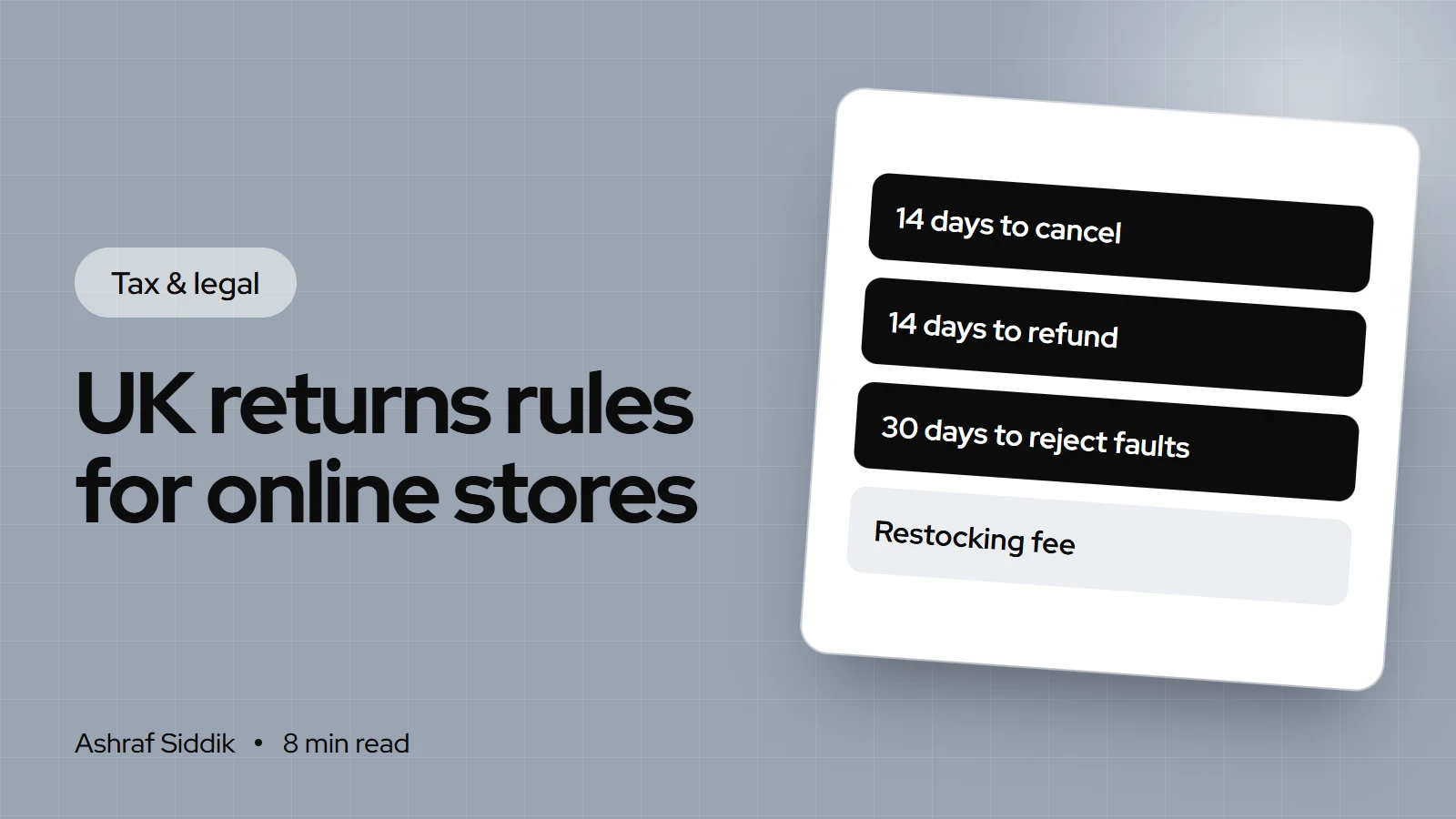
- UK online shoppers have two separate rights: to cancel most orders within 14 days of delivery for any reason, and to reject faulty goods within 30 days under the Consumer Rights Act 2015.
- After canceling, the customer has another 14 days to send the goods back, so a 14-day return window in Shopify is shorter than the law allows.
- You must refund within 14 days of getting the goods back, or of proof they were sent, including your standard outbound delivery charge. Restocking fees aren't allowed on cancellations.
- Set the rules in
Settings > Policies, under Return and cancellation rules, then make your written return policy match them.
- Who it is for
- UK stores selling to consumers online
- Time needed
- About an hour to fix settings and policy
- What you need
- Admin access to Settings > Policies
When people search "Consumer Rights Act returns", they are usually mixing up two different laws. The Consumer Rights Act 2015 covers goods that are faulty, not as described or not fit for purpose. The right to change your mind about an online order comes from a different set of rules, the Consumer Contracts Regulations 2013. An online store has to follow both, and a good returns setup treats them separately.
I set up returns on Shopify stores as part of most UK builds, and the same mistakes come up every time: a 14-day window that's too short, a restocking fee that isn't allowed, and a policy page that says "no refunds on sale items". This guide covers the rules, as published by GOV.UK and Business Companion (the government-backed trading standards guidance) on 7 November 2026, and then the exact Shopify settings.
Two rights, two sets of rules
| Right | Change of mind | Faulty goods |
|---|---|---|
| Law | Consumer Contracts Regulations 2013 | Consumer Rights Act 2015 |
| Time limit | 14 days from the day after delivery | 30 days to reject, then repair or replace |
| Reason needed | None | Fault, not as described or not fit for purpose |
| Refund deadline | 14 days from goods or proof back | 14 days from agreeing a refund |
| Deductions | Only for handling beyond inspection | None within 30 days |
Both rights apply to sale items too. GOV.UK says sale items carry the same refund rights as full-price ones, and it is illegal to take away or mislead customers about their rights, including with a sign saying you don't accept returns.
The 14-day right to cancel, step by step
For most goods bought online, the timeline works like this:
The cancellation timeline for an online order
- To cancel14 daysStarting the day after the goods arrive. With several deliveries, the day after the last one.
- To send back14 daysFrom when the customer told you they're canceling.
- To refund14 daysFrom receiving the goods, or proof of sending, whichever is first.
- If you didn't tell them12 monthsThe longest the cancellation period can be extended.
The details that catch stores out:
- Delivery charges. The refund must include what the customer paid for outbound delivery. If they chose express, you only have to refund your basic delivery cost.
- Return postage. The customer pays to send it back, unless you agreed to pay. If you didn't give the required cancellation information, you pay.
- Deductions. You can deduct only for loss of value caused by handling beyond what's needed to establish what the item is, like trying on clothes beyond how you would in a shop. No cancellation or restocking fees.
- Payment method. Refund to the original payment method unless the customer agrees otherwise.
Items you don't have to take back
The right to cancel doesn't apply to everything. The common exceptions for product stores are:
- Goods made to the customer's specification or clearly personalized, such as engraved jewelry.
- Goods that deteriorate or expire rapidly, such as fresh food and flowers.
- Sealed goods that aren't suitable for return for health or hygiene reasons, once unsealed, like cosmetics or earrings.
- Goods that become mixed with other items after delivery so they can't be separated.
These exceptions are about change-of-mind only. If a personalized item arrives faulty or misspelled, the Consumer Rights Act still applies in full.
Faulty goods under the Consumer Rights Act
- First 30 days. The customer can reject faulty goods and get a full refund. For distance sales, the 30 days start the day after delivery. For goods with a shorter expected life, such as food, the period is shorter.
- Repair or replacement. After 30 days, or if the customer prefers, you must repair or replace at no cost, within a reasonable time and without significant inconvenience.
- One attempt. If one repair or replacement fails, the customer can choose a price reduction or the final right to reject. A refund on final rejection can be reduced for use, but not within six months of supply (except for motor vehicles).
- Six-month rule. A fault that appears within six months is assumed to have been there at delivery, unless you prove otherwise. After six months, the customer has to prove it.
- Six years. Customers can usually bring a claim up to six years after the breach of contract, or five years in Scotland.
Once you agree a refund is due, pay it without undue delay and within 14 days. A warranty or guarantee you offer is on top of these rights, never a replacement for them.
What you must tell customers before they buy
GOV.UK's distance selling guidance lists what you must give customers before they order, in a form they can keep, such as an email. For returns, that means:
- How and when they can cancel, and that they don't need a reason.
- A standard cancellation form, where cancellation is allowed.
- Who pays for return postage. If you don't say the customer does, you pay.
- Your business name, address and contact details.
- The total price including taxes, and delivery costs and timing.
You must also send a copy of the contract in a durable format no later than delivery. In Shopify, the order confirmation email with a link to your policy covers most of this, if the policy itself is complete.
How to set this up in Shopify
- Open the rules. Go to
Settings > Policies. In Return and cancellation rules, click the return rule and turn on return rules. - Set the return window. Shopify offers 14, 30 or 90 days, unlimited or custom. Don't pick 14: the customer gets 14 days to cancel and then 14 days to send the item back. I set 30 days, which covers both with a little room. Under Starting from, choose Delivery of last item in order to match the rule for split deliveries.
- Set return shipping. Choose free returns, a flat fee or customer-bought labels. A fee for change-of-mind returns is fine if your policy says so. Don't take it off a refund for a faulty item, which must be refunded in full.
- Leave the restocking fee empty. Shopify lets you set one, but the law doesn't allow restocking fees on cancellations. Shopify doesn't deduct it automatically anyway, so it only causes confusion.
- Mark final sale items carefully. Use Final sale items only for genuinely exempt products, such as a personalized collection. Don't use it for a clearance collection.
- Set cancellation rules. In the same section, choose how long customers can cancel unfulfilled orders: no cancellations, until the item is fulfilled, 15 minutes, 1 hour or 24 hours. This is a convenience setting and doesn't replace the 14-day right.
- Write the policy. Under Written policies, open the return and refund policy. With Use automated policy on, Shopify keeps it in line with your rules. If you write your own, update it every time you change the rules.
- Turn on self-serve returns if you use customer accounts, so customers can request a return from their order page and you approve it in the admin.
- Make policies easy to find. Shopify links them in the checkout footer automatically. Add them to your footer menu too, and link the returns policy from product pages.
When you issue a refund, include the original standard shipping charge for full-order cancellations. It's the line people forget most often, and it's a legal requirement, not a goodwill gesture.
Common mistakes
- A 14-day return window in Shopify. It rejects returns the customer is still entitled to make.
- "No refunds on sale items." Illegal to state, and it puts off honest buyers.
- Restocking fees or "admin fees" on cancellations. Not allowed.
- Refunding late. 14 days from receiving the goods back, or proof of sending.
- Treating hygiene exceptions as "all cosmetics". The exception only applies once a sealed item has been unsealed.
- Making faulty items go through the change-of-mind process, with a return fee taken off. A rejected faulty item gets a full refund.
Returns compliance checklist
- Return window set to at least 28 days, starting from the last delivery.
- No restocking fee, and return shipping costs stated clearly in the policy.
- Final sale used only for personalized, perishable or unsealed hygiene items.
- Return policy covers cancellation, the model form, faulty goods and refund timing.
- Policies linked in the footer, at checkout and from product pages.
- Your business name, address and email shown on the contact information policy.
- Staff know refunds include standard outbound delivery and must be paid within 14 days.
Next steps
Open Settings > Policies today and compare your return window, fees and policy text with the checklist above. A clear, fair returns policy also helps sales: in my CRO audit checklist, returns information near the add to cart button is one of the trust signals I look for first.
If you sell products with extra rules, read how to sell age-restricted products online and product safety and labeling rules next. Want your returns setup and policies checked? I work with UK stores as a Shopify developer in the UK, and you can start with a free store review.
Free tools
Check your own store
Free, no sign-up. Each one runs a part of this guide for you.
Frequently asked questions
How long do customers have to return items bought online in the UK?
For most goods, 14 days to cancel, starting the day after delivery, and then another 14 days to send the goods back. Faulty goods are covered separately: customers can reject them within 30 days for a full refund under the Consumer Rights Act 2015.
Do I have to refund the delivery charge?
Yes, when a customer cancels the whole order you must refund the outbound delivery they paid. If they chose a more expensive option, such as express delivery, you only have to refund your basic delivery cost.
Who pays for return postage?
For change-of-mind returns, the customer pays, as long as you told them before they bought. If you didn't give that information, you pay. Faulty goods that are rejected must get a full refund, so don't take a return fee off it.
Can I charge a restocking fee in the UK?
Not on cancellations under the Consumer Contracts Regulations. You may only deduct for loss of value caused by handling the goods beyond what was needed to inspect them.
What items can't be returned?
The main exceptions to the right to cancel are personalized or made-to-order goods, goods that deteriorate rapidly, and sealed health or hygiene items that have been unsealed. These exceptions don't affect the customer's rights if the item is faulty.
How quickly must I give a refund?
Within 14 days of getting the goods back, or of receiving proof they were sent back, whichever is earlier. For faulty goods, refund within 14 days of agreeing the customer is entitled to one.
Is this legal advice?
No. It is general information from UK government guidance, checked on 7 November 2026. For a specific dispute or product, contact your local Trading Standards service or a solicitor.
Sources
- Online and distance selling for businesses, GOV.UK
- Accepting returns and giving refunds, GOV.UK
- Consumer contracts: distance sales, Business Companion
- Selling and supplying goods, Business Companion
- How the CMA uses its direct consumer enforcement powers, GOV.UK
- Return rules, Shopify Help Center
Related services and work

I'm a Shopify developer and CRO specialist. I have built and improved Shopify stores since 2018, completed more than 1,000 projects, and hold a 4.96 average rating across 719 client reviews.
More guides
-
Why Shopify Stores Lose Sales on Mobile: A Practical CRO Checklist
Mobile visitors decide fast, with one thumb and plenty of distractions. Here is how to find the leaks on a Shopify store and fix them in the right order.
-
Shopify CRO Audit Checklist for DTC Brands
The checklist I use to audit DTC Shopify stores, from checking that the data can be trusted to deciding which fixes to ship first.
-
When to Build a Custom Shopify App Instead of Adding Another Subscription
Another subscription is the quickest fix, until you are paying for five apps that still don't match how your business works. Here is how to decide.
-
How to Find Out What Theme a Shopify Store Uses
Every Shopify store names its theme in the page code. Here is where to look, how to read what you find, and what it means for your own theme choice.
-
How to See What Apps a Shopify Store Uses
Apps leave traces in a store's page code: scripts from their own servers, app embed folders and pixel settings. Here is how to read them, and what to do with the list.
-
How to Name a Shopify Store (and Check the Name Is Free)
A store name has to be easy to say, free as a domain and a handle, and clear of other brands. Here is the process I use with clients, and what Shopify lets you change later.