Shopify questionAnswer4 min read
Is .co.uk or .com Better for a UK Online Store?
For a store that sells only in the UK, .co.uk is a safe, trusted choice. If you plan to sell abroad, a .com is easier to grow from. Here is how to decide and set it up on Shopify.
Key takeaways
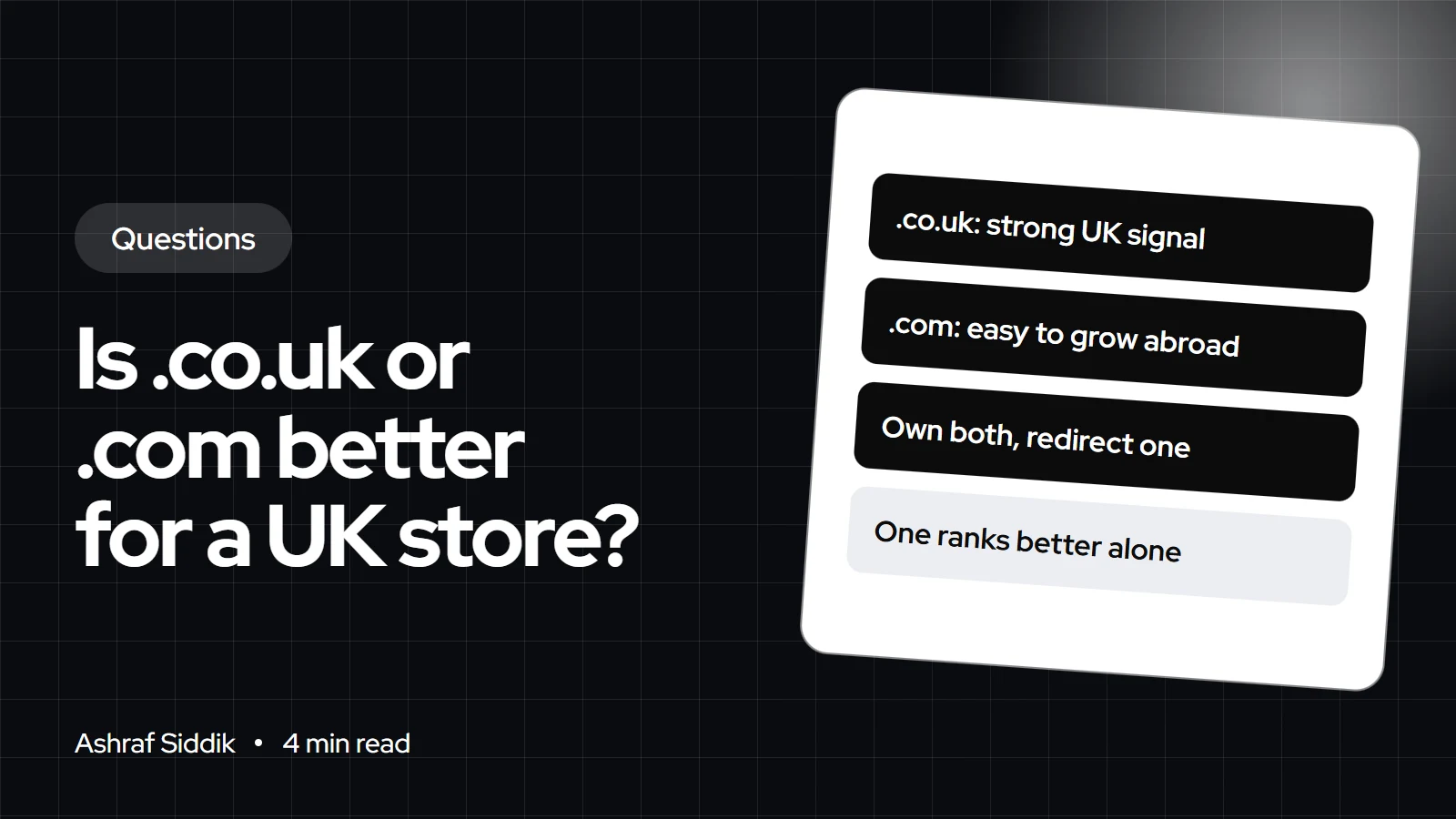
- A .co.uk tells Google and shoppers your store is for the UK. Google calls country domains "a strong signal" of the target country.
- That signal works against you abroad: a country domain targets only one country, so a .co.uk is a weak base for EU, US or Australian sales.
- A .com has no country attached, so it works for one market or many, using Shopify Markets subfolders such as /en-gb/ and /en-us/.
- Buy both if you can. Shopify sells .co.uk and .com, and any extra domain you add redirects to your primary one.
- Who it is for
- UK store owners choosing a domain
- Time needed
- 4 minutes to read
- What you need
- Your shortlisted store names
For a store that will only ever sell to UK customers, .co.uk is the better choice: it signals a UK business to shoppers and to Google, and it's often available when the .com isn't. If you plan to sell outside the UK within the next few years, pick .com as your main domain and use Shopify Markets to serve each country. Owning both, with one redirecting to the other, removes most of the risk.
I build Shopify stores for UK brands, and the domain question comes up on almost every new build. The guidance below uses Google Search Central and Shopify's Help Center, checked on 7 November 2026.
What Google says about country domains
Google's guidance on multi-regional sites says country-code domains such as .co.uk "provide a strong signal to both users and search engines" that a site targets that country. A .com is a generic domain with no location, so if it targets one country, you tell Google through other means, such as hreflang tags or regional subfolders.
Google also lists the downside of country domains: each one targets only one country, costs more to run when you have several, and needs its own authority built from scratch. Nothing in Google's guidance says a .co.uk ranks better in the UK by itself. The signal helps Google understand who the site is for, and your content and links do the ranking.
.co.uk vs .com side by side
| Factor | .co.uk | .com |
|---|---|---|
| Country signal | Strong UK signal | None by default |
| UK shopper trust | Reads as a UK business | Neutral |
| Selling abroad | Weak base | Easy with subfolders |
| Availability | Often free | Often taken |
| Bought through Shopify | Yes | Yes |
How I'd decide
Choosing your main domain
- 1
Will you sell outside the UK in the next 2 to 3 years?
Yes: make .com the primary domainNo: go to question 2
- 2
Is the .com for your name available at a fair price?
Yes: buy both, pick one as primaryNo: go to question 3
- 3
Is the .co.uk available?
Yes: use .co.uk as your primary domainNo: rethink the store name
A good name on the right domain beats a forced name on a taken one.
If the .com of your name belongs to an unrelated US company, think twice before using the .co.uk. Shoppers who type .com by habit will land on someone else's site.
Setting it up on Shopify
- Buy or connect your domains. Go to
Settings > Domains. Shopify sells both .co.uk and .com, registered for a year at a time, with renewals billed separately from your plan. Shopify's list doesn't include plain .uk. - Choose your primary domain. The primary domain is the one customers see. Any other domain you add redirects to it, so a shopper who types the .co.uk still reaches your .com store, or the other way round.
- Add markets when you sell abroad. Shopify supports country domains, subdomains and subfolders on the Basic plan or higher. For a first international setup, Shopify recommends subfolders, because they share your main domain's ranking.
- Keep email consistent. Use the same domain for your business email as your store, so order emails match the address shoppers see.
If you're outside the UK
- Netherlands: the same logic applies to .nl vs .com. A .nl suits a Dutch-only store, and a .com with /nl/ and /en/ subfolders suits a store selling across the EU.
- Australia: .com.au is a strong local signal for an Australia-only store. A .com with an /en-au/ subfolder works if you also sell to New Zealand or the US.
- US: .com is the default, and US shoppers rarely see .us on stores.
What to do next
- Shortlist names with a free domain. The Shopify domain name generator suggests names, and my guide on how to name a Shopify store covers trademarks and length.
- Connect your domain and email with my guide to connecting a domain and business email to Shopify.
- Plan for growth. If you'll sell abroad, read international SEO for Shopify before you launch. I also build stores for UK merchants, starting from $300.
Free tools
Check your own store
Free, no sign-up. Each one runs a part of this guide for you.
Frequently asked questions
Does a .co.uk domain help UK SEO?
It helps Google understand that your store targets the UK, because Google treats country domains as a strong signal of the target country. It doesn't make pages rank by itself. Content, links and a good store still do that work.
Can a .com store rank well in the UK?
Yes. A .com has no country attached, so you tell Google who each page is for with hreflang tags and regional subfolders. Shopify Markets adds these for you when you set up a UK market.
Should I buy both .co.uk and .com?
If both are available, yes. Pick one as your primary domain in Settings > Domains, and Shopify redirects the other to it. That protects your brand and catches shoppers who type the wrong ending.
Can I buy a .co.uk domain on Shopify?
Yes. .co.uk is on Shopify's list of domain endings you can buy in the admin. Plain .uk isn't on the list, so you'd buy that from another registrar and connect it.
Can I switch from .co.uk to .com later?
Yes. Add the new domain in Settings > Domains and make it primary, and the old one redirects to it. Expect a short wobble in rankings while Google processes the change, so do it at a quiet time of year.
Is .uk better than .co.uk?
.co.uk is the long-standing UK ending most shoppers recognize. Both carry the same UK country signal, so the choice is about which version of your name is free and easy to remember.
Sources
- Managing multi-regional and multilingual sites, Google Search Central
- Buying a domain through Shopify, Shopify Help Center
- International domains, Shopify Help Center
- Domains, Shopify Help Center
- SEO for markets, Shopify Help Center
Related services and work

I'm a Shopify developer and CRO specialist. I have built and improved Shopify stores since 2018, completed more than 1,000 projects, and hold a 4.96 average rating across 719 client reviews.
More guides
-
Why Shopify Stores Lose Sales on Mobile: A Practical CRO Checklist
Mobile visitors decide fast, with one thumb and plenty of distractions. Here is how to find the leaks on a Shopify store and fix them in the right order.
-
Shopify CRO Audit Checklist for DTC Brands
The checklist I use to audit DTC Shopify stores, from checking that the data can be trusted to deciding which fixes to ship first.
-
When to Build a Custom Shopify App Instead of Adding Another Subscription
Another subscription is the quickest fix, until you are paying for five apps that still don't match how your business works. Here is how to decide.
-
How to Find Out What Theme a Shopify Store Uses
Every Shopify store names its theme in the page code. Here is where to look, how to read what you find, and what it means for your own theme choice.
-
How to See What Apps a Shopify Store Uses
Apps leave traces in a store's page code: scripts from their own servers, app embed folders and pixel settings. Here is how to read them, and what to do with the list.
-
How to Name a Shopify Store (and Check the Name Is Free)
A store name has to be easy to say, free as a domain and a handle, and clear of other brands. Here is the process I use with clients, and what Shopify lets you change later.