Shopify questionAnswer4 min read
How Much Does a Custom Shopify App Cost?
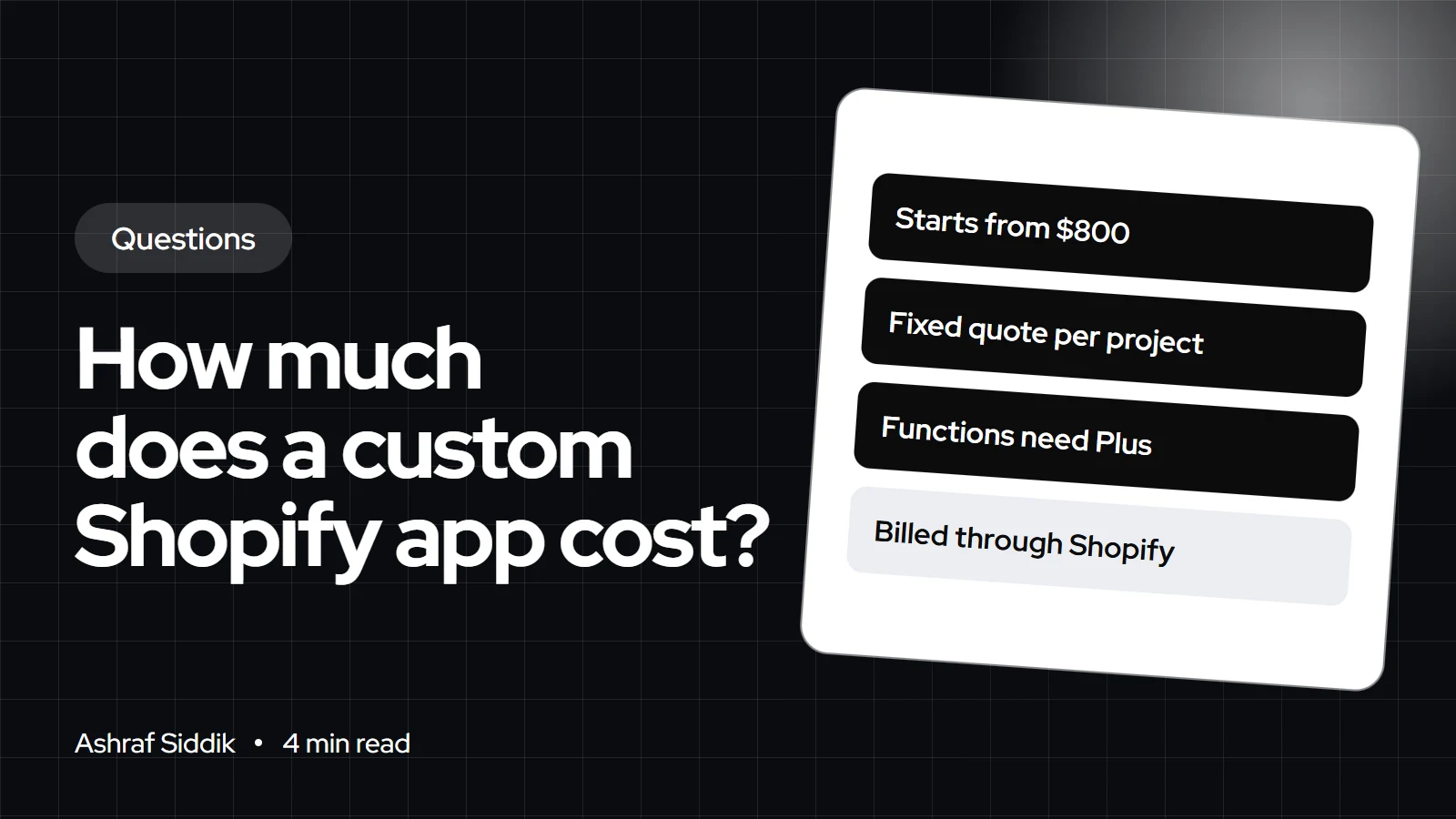
My custom Shopify app work starts from $800, with a fixed quote for every project. Here is what moves the price, the Shopify rules that shape a build, and what it costs to run afterwards.
Key takeaways
- My custom Shopify app development starts from $800, and every project gets a fixed quote once I've seen the scope.
- A custom app installs on one store, or several stores in the same Plus organization, and can't charge merchants through Shopify's app billing system.
- Custom apps that contain Shopify Functions only work on Shopify Plus stores, as Shopify's developer docs stated on 7 November 2026.
- Running costs are hosting, if the app has its own server, and maintenance as Shopify updates its APIs.
- Who it is for
- Store owners with a process no app handles
- Time needed
- 5 minutes to read
- What you need
- A short description of what the app should do
A custom Shopify app costs what its scope demands, and my custom app work starts from $800 with a fixed quote for each project. The price is driven by what the app connects to, whether it needs its own screens in the Shopify admin, and where it runs. Before paying for any build, check whether an existing App Store app or a theme change already does the job.
What drives the price
| Driver | Lower cost | Higher cost |
|---|---|---|
| Where it runs | Inside Shopify, as extensions | Own server and database |
| Data sources | Shopify data only | ERP, warehouse or other APIs |
| Admin screens | None, settings only | Embedded admin pages |
| Checkout logic | Not needed | Functions, Plus only for custom apps |
| Data access | Products and orders | Customer personal data |
The single biggest factor is integrations. An app that only reads and writes Shopify data is a small build. One that syncs stock with a warehouse system, retries failed calls and logs errors for your team is several times the work, because most of the effort goes into what happens when the other system misbehaves.
Custom app or public app
Shopify's developer docs, as checked on 7 November 2026, describe two ways to distribute an app:
- Custom distribution. Built for one merchant, installed on a single store, several stores in the same Plus organization, or development stores. No Shopify review is needed, but the app can't charge through Shopify's billing system.
- Public distribution. Listed on the Shopify App Store, reviewed and approved by Shopify, and the developer pays a one-time registration fee.
Custom apps are now created and managed in the Dev Dashboard. Shopify says custom apps made in the store admin can't be created anymore, though existing ones keep working, and legacy custom apps created before 1 January 2026 can still be managed from the admin.
Plan limits that change the build
Two Shopify rules decide what's possible on your plan. First, only stores on Shopify Plus can use custom apps that contain Shopify Function APIs, which power custom discounts, payment and delivery customizations. On Basic, Grow or Advanced, the same logic needs a public app that uses Functions or a different approach. Second, custom apps that access Level 2 protected customer data, such as names and addresses, need the store to be on Grow or higher.
Build or buy
Should you build a custom app?
- 1
Does an App Store app do 90% of what you need?
Yes: install it and adapt your processNo: go to question 2
- 2
Will the app subscription cost more than a build over two years?
Yes: a custom app is worth pricingNo: keep the subscription
- 3
Does it need checkout logic on a non-Plus store?
Yes: look at public Functions apps firstNo: a custom app fits
Most stores I review need fewer apps, not more. Build only what nothing else does well.
My guide to custom Shopify apps vs app subscriptions runs the numbers in more detail, and Shopify app costs shows what the subscription side typically adds up to.
Running costs after launch
- Hosting. Apps with their own server and database pay a monthly hosting bill. Apps built only from Shopify extensions avoid most of it.
- API updates. Shopify updates its APIs over time, so a custom app needs occasional updates to keep working.
- Changes. New fields, new rules and new staff requests. Budget for small changes each year.
My Shopify maintenance cost guide covers how to budget for this.
Clients outside the US
I quote in $ for clients in the US, the UK, the EU and Australia, so the starting price is the same everywhere. What changes by country is data handling: if the app stores customer data, UK GDPR or EU GDPR applies to how it's stored and for how long, and the app should only keep what it needs.
What to do next
- Write down the job. What should happen, when, and who uses it.
- List the systems. Every tool the app must talk to, with links to their API docs if you have them.
- Note your Shopify plan. It decides whether Functions are an option.
- Ask for a fixed quote. Send the brief through my quote form, or read more about my custom app development.
Free tools
Check your own store
Free, no sign-up. Each one runs a part of this guide for you.
Frequently asked questions
How much does it cost to build a custom Shopify app?
My custom Shopify app development starts from $800. Every project gets a fixed quote after I've reviewed what the app needs to do and which systems it connects to.
What is the difference between a custom app and a public app?
A custom app is built for one merchant and installs on a single store or stores in one Plus organization, with no Shopify review. A public app is listed on the App Store, reviewed by Shopify and can bill merchants through Shopify.
Can I still create a custom app in the Shopify admin?
No. Shopify says admin-created custom apps can't be created anymore, although existing ones keep working. New custom apps are created and managed in the Dev Dashboard.
Do custom Shopify apps need Shopify Plus?
Only if they contain Shopify Functions. Shopify's docs say only Plus stores can use custom apps with Function APIs. Other custom apps work on any paid plan, and apps using Level 2 customer data need Grow or higher.
Can a custom app charge a monthly fee through Shopify?
No. Custom distribution apps can't charge merchants through Shopify's app billing system, so any ongoing cost is agreed directly with the developer.
Are there ongoing costs after the app is built?
Usually. Apps with their own server need hosting, and every custom app needs occasional updates as Shopify's APIs change.
Sources
- Select a distribution method, Shopify.dev
- Custom apps, Shopify Help Center
- Shopify Functions, Shopify.dev
Related services and work

I'm a Shopify developer and CRO specialist. I have built and improved Shopify stores since 2018, completed more than 1,000 projects, and hold a 4.96 average rating across 719 client reviews.
More guides
-
Why Shopify Stores Lose Sales on Mobile: A Practical CRO Checklist
Mobile visitors decide fast, with one thumb and plenty of distractions. Here is how to find the leaks on a Shopify store and fix them in the right order.
-
Shopify CRO Audit Checklist for DTC Brands
The checklist I use to audit DTC Shopify stores, from checking that the data can be trusted to deciding which fixes to ship first.
-
When to Build a Custom Shopify App Instead of Adding Another Subscription
Another subscription is the quickest fix, until you are paying for five apps that still don't match how your business works. Here is how to decide.
-
How to Find Out What Theme a Shopify Store Uses
Every Shopify store names its theme in the page code. Here is where to look, how to read what you find, and what it means for your own theme choice.
-
How to See What Apps a Shopify Store Uses
Apps leave traces in a store's page code: scripts from their own servers, app embed folders and pixel settings. Here is how to read them, and what to do with the list.
-
How to Name a Shopify Store (and Check the Name Is Free)
A store name has to be easy to say, free as a domain and a handle, and clear of other brands. Here is the process I use with clients, and what Shopify lets you change later.