Shopify questionAnswer4 min read
How Much Should I Spend on Packaging?
Plain packaging costs cents per order. The bigger cost is often what the box does to your shipping rate, so here are real prices, a budget rule and the size trap to avoid.
Key takeaways
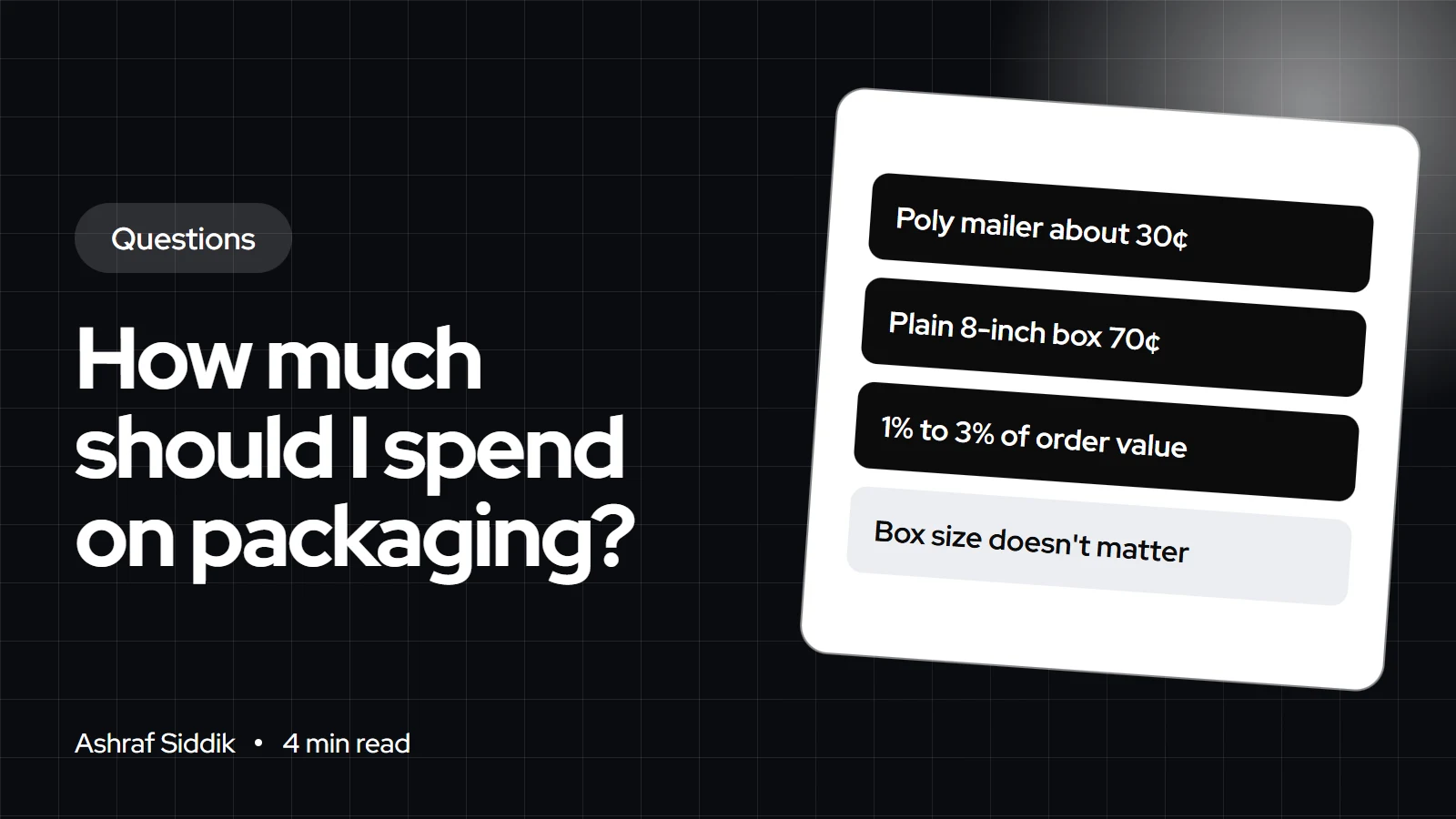
- Plain shipping packaging costs cents per order. Uline listed an 8 x 8 x 8 inch box at 70¢ and 10 x 13 inch poly mailers at $30 per 100, as checked on 7 November 2026.
- My rule of thumb: keep everyday packaging to 1% to 3% of the order value, and spend more only where the unboxing is part of what customers pay for.
- Box size can cost more than the box. USPS Ground Advantage charges by dimensional weight once a parcel is over 1 cubic foot, dividing the volume by 139.
- Shopify adds your default package weight to every order's shipping weight, so set it accurately.
- Who it is for
- Store owners budgeting for packaging
- Time needed
- 5 minutes to read
- What you need
- Your product sizes and weights
Most small stores should spend well under $1 per order on the packaging itself: a poly mailer costs about 30¢ and a plain 8-inch box 70¢ at Uline's listed prices on 7 November 2026. Tape, filler and an insert add a little more. Spend on branded packaging only when your order value can carry it, and check that a bigger box doesn't push you into dimensional-weight pricing.
What plain packaging costs
| Item | Listed price | Per unit |
|---|---|---|
| 10 x 13 in poly mailer | $30 per 100 | 30¢, or 26¢ at 20+ cases |
| 8 x 8 x 8 in box | 70¢ | 70¢ at any quantity |
| 10 x 10 x 8 in box | $1.38 at 25 | 90¢ at 1,000+ |
| Custom printed box | Quoted | Falls with order size |
Prices are from Uline's product pages. Plain packaging gets cheaper with volume, but only slowly, so don't tie up cash in 1,000 boxes until you know which sizes you use.
A simple packaging budget rule
I tell clients to keep everyday packaging at 1% to 3% of the average order value. On a $40 order, that is 40¢ to $1.20, enough for a good mailer or plain box with a printed insert. Go above that only where the packaging is part of the product: gifts, subscription boxes, premium skincare or jewelry.
Why box size matters more than box price
USPS rules for Ground Advantage set the price on the greater of actual weight and dimensional weight once a parcel exceeds 1,728 cubic inches. Dimensional weight is length times width times height, divided by 139 and rounded up.
Same 3 lb product, two box sizes
- 12 x 12 x 12 in box3 lb billed1,728 cubic inches, not over the threshold.
- 13 x 13 x 13 in box16 lb billed2,197 divided by 139, rounded up.
One inch on each side turned a 3 lb parcel into a 16 lb one. That is why I check box sizes before box prices. My guide to reducing shipping costs for a small store covers the other levers.
Set your packaging up in Shopify
Shopify uses your store default package to calculate weight-based and carrier-calculated shipping rates at checkout, and it adds the package's weight to the products' weight. Shopify's own example shows a 0.1825 kg package moving a 4.9 kg order into a higher rate band. Measure outside dimensions, because those are what carriers charge on. Packages live in Settings > Shipping and delivery, and my guide to setting up shipping rates and zones walks through the rest.
When branded packaging is worth it
- Your order value is high enough that $2 to $5 of packaging is under 3% of it.
- Customers share unboxing on social media in your category.
- The product is bought as a gift and arrives straight to the recipient.
If sustainability is part of your brand, my guide to choosing eco-friendly packaging covers materials and claims.
In the UK, EU and Australia
The same principle applies everywhere: carriers price by size band as well as weight. Royal Mail and Evri in the UK, PostNL in the Netherlands and Australia Post all have size limits that decide which price you pay, so a flatter pack can drop into a cheaper band. Packaging suppliers in those countries price in £, € or A$, so compare per-unit costs at the quantity you will really order.
What to do next
- Measure your products. Pick the two or three box or mailer sizes that fit 90% of orders.
- Set packages in Shopify. Enter outside dimensions and weights.
- Price it into your margin. Add packaging to your cost per order in my free profit margin calculator.
Free tools
Check your own store
Free, no sign-up. Each one runs a part of this guide for you.
Frequently asked questions
How much does packaging cost for a small business?
Plain packaging is cheap. Uline listed 10 x 13 inch poly mailers at 30¢ each and an 8 x 8 x 8 inch box at 70¢ on 7 November 2026. Tape, filler and inserts add a little more per order.
How much does custom packaging cost?
Custom printed boxes and mailers are quoted per order, and the unit price falls as the quantity rises. Get quotes at two or three quantities before you order, and compare them with a plain box plus a printed insert.
What percentage of the order should packaging cost?
My rule of thumb is 1% to 3% of the average order value for everyday orders. Spend more only for gifts, subscriptions or premium products where the unboxing is part of the value.
What is dimensional weight?
It's a shipping weight based on the box's size rather than its contents. For USPS Ground Advantage, parcels over 1,728 cubic inches are charged on length times width times height divided by 139, if that's higher than the actual weight.
Should I use mailers or boxes?
Use poly or paper mailers for soft, unbreakable products, because they're cheaper and lighter. Use boxes for fragile items or anything that needs to arrive in perfect shape.
Is there a packaging cost calculator?
Add your packaging cost per order to a profit margin calculator alongside product cost, fees and shipping. That shows whether a packaging upgrade still leaves a healthy margin.
Sources
- 8 x 8 x 8 inch corrugated boxes, Uline
- 10 x 10 x 8 inch corrugated boxes, Uline
- Poly mailers, 10 x 13 inch, Uline
- 283 USPS Ground Advantage, Commercial, USPS Postal Explorer
- Packages, Shopify Help Center
Related services and work

I'm a Shopify developer and CRO specialist. I have built and improved Shopify stores since 2018, completed more than 1,000 projects, and hold a 4.96 average rating across 719 client reviews.
More guides
-
Why Shopify Stores Lose Sales on Mobile: A Practical CRO Checklist
Mobile visitors decide fast, with one thumb and plenty of distractions. Here is how to find the leaks on a Shopify store and fix them in the right order.
-
Shopify CRO Audit Checklist for DTC Brands
The checklist I use to audit DTC Shopify stores, from checking that the data can be trusted to deciding which fixes to ship first.
-
When to Build a Custom Shopify App Instead of Adding Another Subscription
Another subscription is the quickest fix, until you are paying for five apps that still don't match how your business works. Here is how to decide.
-
How to Find Out What Theme a Shopify Store Uses
Every Shopify store names its theme in the page code. Here is where to look, how to read what you find, and what it means for your own theme choice.
-
How to See What Apps a Shopify Store Uses
Apps leave traces in a store's page code: scripts from their own servers, app embed folders and pixel settings. Here is how to read them, and what to do with the list.
-
How to Name a Shopify Store (and Check the Name Is Free)
A store name has to be easy to say, free as a domain and a handle, and clear of other brands. Here is the process I use with clients, and what Shopify lets you change later.