Shopify glossaryGlossary4 min read
What Is Print on Demand? How It Works with Shopify
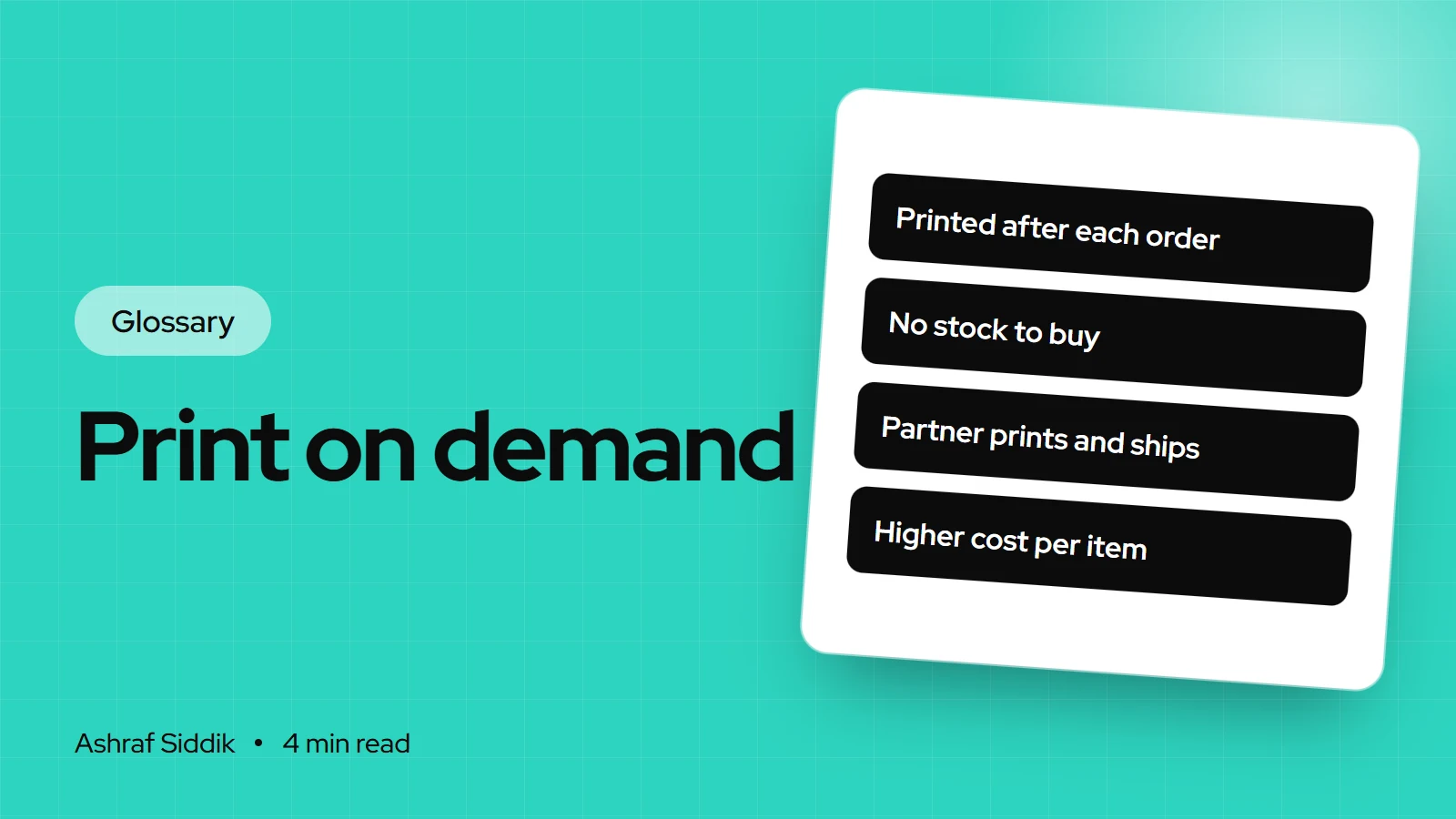
Print on demand lets you sell your own designs on T-shirts, mugs and posters without buying stock, because each item is printed after the order. Here is how it works with a Shopify store and what is left after costs.
Key takeaways
- Print on demand means a partner prints your design onto a blank product only after a customer orders it, then ships it under your store's name.
- It is a type of dropshipping. The difference is that the product carries your design instead of being an existing supplier product.
- Cost per item is higher than printing in bulk, so margins are smaller. In the worked example below, a $28 T-shirt leaves $9.89 before marketing.
- On Shopify, a print-on-demand app such as Printful, Printify or Gelato creates the products and receives orders automatically.
- Who it is for
- Creators and new brands
- Time needed
- 4 minutes to read
- What you need
- Your designs and a POD app
Print on demand (POD) is a business model where products such as T-shirts, mugs, posters or books are printed one at a time after a customer buys them, by a partner who also packs and ships the order. You create the designs and sell them under your brand, and you never hold inventory.
A print on demand company or platform is the partner that does the printing. The Shopify details below were checked on Shopify's help center and blog on 7 November 2026.
How print on demand works
- Choose a partner. Install a print-on-demand app and browse its catalog of blank products.
- Upload your design. Place your artwork on the product and generate mockup images. Shopify recommends 300 dpi files for printing.
- Publish to your store. The app creates the product, its variants and images in Shopify. You set the retail price.
- A customer orders. The order is forwarded to the partner automatically.
- They print and ship. The partner prints the item, packs it and sends it to your customer.
- The order updates. Print-on-demand apps usually mark items fulfilled when the order ships, and the tracking number reaches the customer.
Shopify's guide names three common services: Printful, with a wide catalog; Printify, strong on T-shirts and hoodies; and Gelato, with more than 140 printing partners in 32 countries.
A worked margin example
These are example figures, not a quote from any provider. Swap in the real base price and shipping from your app.
| Line | Cost | Left over |
|---|---|---|
| T-shirt sale price | – | $28.00 |
| Blank shirt and printing | $12.50 | $15.50 |
| Shipping to customer | $4.50 | $11.00 |
| Card fee (2.9% + 30¢) | $1.11 | $9.89 |
That is about 35% before ads, apps, returns and reprints. If an ad costs you $8 per sale, you keep under $2. This is why Shopify's guide calls POD a lower-margin model and stresses a clear niche. Check your own numbers in the profit margin calculator.
Print on demand vs other models
| Model | Upfront stock | Cost per item | Product |
|---|---|---|---|
| Print on demand | None | Higher | Your design, printed to order |
| Dropshipping | None | Medium | Supplier's existing product |
| Bulk printing | Full print run | Lowest | Your design, made in advance |
Many brands start with POD to test designs, then move best sellers to a bulk print run once demand is proven. See dropshipping for the wider model POD belongs to.
Where print on demand shows up in Shopify
- Apps: the partner's app lives in your admin, and you design and publish from there.
- Products: each design becomes a normal Shopify product, with sizes and colors as product variants. You can edit the description, SEO fields and collections like any other product.
- Orders: POD items are routed to the app's fulfillment location. One order can mix POD items with products you ship yourself.
- Shipping rates: set rates at checkout that cover what the partner charges you, or the shipping line eats your margin.
Common misconceptions
- Any design is fair game. No. Printing a brand logo, film character or someone else's artwork can infringe trademark or copyright, and you are the seller.
- Quality is the same everywhere. Print quality, blanks and packaging vary by partner and by facility. Order samples of your best sellers.
- Returns are the partner's problem. Check each partner's policy on print defects, and remember that a customer who ordered the wrong size is your cost to handle.
- Complex customization works. Shopify notes that complex custom design requests are often not supported. Check what the app can do before you promise it.
Related terms
- Dropshipping: selling a supplier's stock without holding it.
- Mockup: a generated image of your design on the product.
- Blank: the unprinted product, such as a plain T-shirt.
- DTG printing: direct-to-garment, a common print method for one-off shirts.
What to do next
- Order samples of three or four products and check print quality, sizing and packaging.
- Price from the full cost, including shipping and a realistic marketing cost per sale.
- Use your own photos once you have samples. They build more trust than mockups alone.
- Build a store that fits the model. I set up stores for print-on-demand brands, and every project starts with a free review.
Free tools
Check your own store
Free, no sign-up. Each one runs a part of this guide for you.
Frequently asked questions
What is print on demand?
Print on demand is a way of selling custom-designed products where each item is printed only after a customer orders it. A partner handles the printing and shipping, so you don't buy or store any stock.
Is print on demand the same as dropshipping?
It's a type of dropshipping. In both, a partner ships to your customer and you hold no stock. The difference is that print-on-demand products carry your own designs and are made after the order.
Which print on demand apps work with Shopify?
Shopify's own guide names Printful, Printify and Gelato. Each connects to your store through an app, creates the products for you and receives orders automatically.
Is print on demand profitable?
It can be, but margins are smaller than bulk printing because each item costs more to make. In my example a $28 T-shirt leaves about $9.89 before ads, so a clear niche and low marketing cost per sale matter.
Do I need my own designs for print on demand?
Yes. You need artwork you created or have the rights to use. Shopify recommends 300 dpi files for good print quality.
Sources
- Print on demand: how to start a business, Shopify
- Fulfilling orders with apps and fulfillment services, Shopify Help Center
- What is dropshipping, Shopify
Related services and work

I'm a Shopify developer and CRO specialist. I have built and improved Shopify stores since 2018, completed more than 1,000 projects, and hold a 4.96 average rating across 719 client reviews.
More guides
-
Why Shopify Stores Lose Sales on Mobile: A Practical CRO Checklist
Mobile visitors decide fast, with one thumb and plenty of distractions. Here is how to find the leaks on a Shopify store and fix them in the right order.
-
Shopify CRO Audit Checklist for DTC Brands
The checklist I use to audit DTC Shopify stores, from checking that the data can be trusted to deciding which fixes to ship first.
-
When to Build a Custom Shopify App Instead of Adding Another Subscription
Another subscription is the quickest fix, until you are paying for five apps that still don't match how your business works. Here is how to decide.
-
How to Find Out What Theme a Shopify Store Uses
Every Shopify store names its theme in the page code. Here is where to look, how to read what you find, and what it means for your own theme choice.
-
How to See What Apps a Shopify Store Uses
Apps leave traces in a store's page code: scripts from their own servers, app embed folders and pixel settings. Here is how to read them, and what to do with the list.
-
How to Name a Shopify Store (and Check the Name Is Free)
A store name has to be easy to say, free as a domain and a handle, and clear of other brands. Here is the process I use with clients, and what Shopify lets you change later.