Shopify glossaryGlossary4 min read
What Is Conversion Rate Optimization (CRO)? A Plain-English Guide for Shopify Stores
Conversion rate optimization is the practice of getting more of your existing visitors to buy. Here is how the process works, the math behind it and where to start on a Shopify store.
Key takeaways
- Conversion rate optimization (CRO) is the process of finding why visitors don't buy, fixing those causes and measuring the result, so more of your existing traffic turns into orders.
- Good CRO is research first: analytics, heatmaps, session recordings and customer feedback decide what to change, and testing confirms it.
- The payoff compounds: revenue = sessions × conversion rate × average order value, so a better rate lifts every channel you pay for.
- Shopify's Conversion rate breakdown, Sessions by device and search reports, plus Rollouts experiments, cover most of the groundwork.
- Who it is for
- Stores with traffic but too few sales
- Time needed
- 4 minutes to read
- What you need
- Your Shopify reports
Conversion rate optimization (CRO) is the practice of increasing the share of website visitors who take a desired action, which for an online store usually means placing an order. It works by finding what stops people from buying, changing it, and measuring whether the change helped.
CRO is my core service, so I'll be direct about what it is and isn't. It isn't button colors, and it isn't copying another store's layout. It's a structured way to find the specific reasons your shoppers hesitate, then remove them in order of value. Shopify report names below were checked on 7 November 2026.
Why CRO matters: the revenue math
Revenue = sessions × conversion rate × average order value
Most stores try to grow the first term by buying more traffic. CRO grows the second and third using the traffic you already have. An illustrative store:
Same traffic, better conversion (illustrative)
- Before$37,80030,000 sessions × 1.8% × $70.
- After$42,00030,000 sessions × 2.0% × $70.
- Extra per month$4,200With no extra ad spend.
It also lowers customer acquisition cost, because the same ad spend now produces more first orders. That's why I tell clients to fix conversion before raising budgets.
How the CRO process works
- Measure the funnel. Where do sessions drop: product page to cart, cart to checkout, or inside checkout? Split by device and traffic source.
- Research the why. Heatmaps and session recordings show behavior. Reviews, support emails, on-site search terms and short surveys show doubts in customers' own words.
- Prioritize. Score each issue by how many sessions it touches, how bad the leak looks and how hard the fix is.
- Change and test. Run an A/B test where traffic allows. On smaller stores, ship clear fixes and watch the trend.
- Learn and repeat. Every result, win or loss, tells you something about your customers that shapes the next round.
Where Shopify stores usually leak
| Area | Typical issue | What I check |
|---|---|---|
| Product page | Doubts left unanswered | Delivery, returns, sizing, reviews near the price |
| Mobile layout | Key content too far down | Scroll reach, sticky add to cart, image load |
| Collection page | Hard to find the right item | Filters, sorting, product card details |
| Site search | Searches that find nothing | Zero-result terms and synonyms |
| Cart | Surprise costs | Shipping shown early, free shipping progress |
| Checkout | Friction and trust | Express payments, form fields, payment options |
Where to start in Shopify and GA4
- Conversion rate breakdown in
Analytics > Reportsshows sessions that added to cart, reached checkout and completed checkout. - Sessions by device and Sessions by landing page show which devices and entry pages underperform.
- Searches with no clicks and Top online store searches with no results show what shoppers wanted and couldn't find.
- Rollouts under
Markets > Rolloutsruns experiments on the Grow plan or higher. - In GA4, the Checkout journey report under
Reports > Monetizationshows drop-off between checkout steps.
Common misconceptions
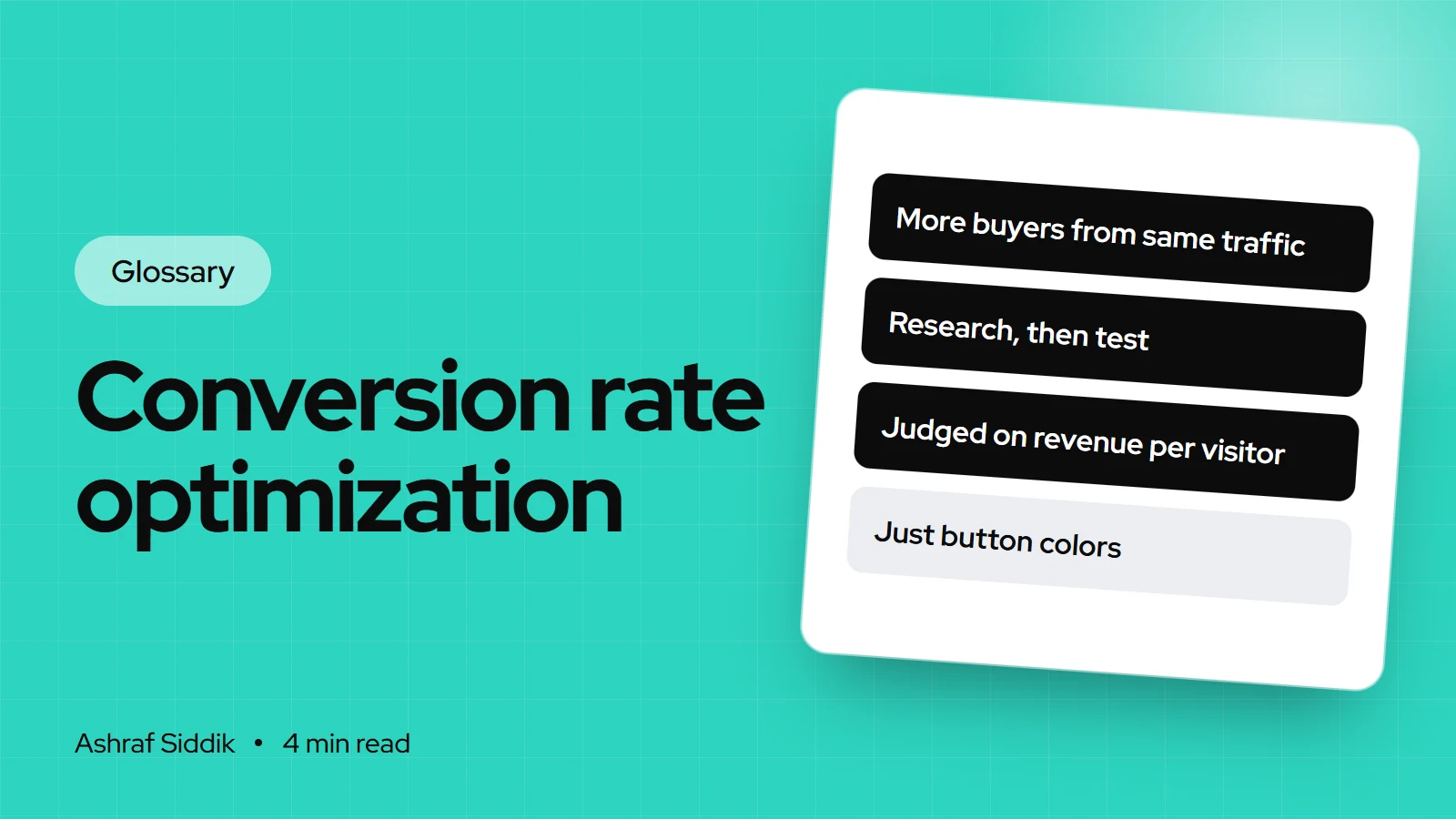
- "CRO is A/B testing." Testing is one tool. Most of the value comes from research that finds the right problem.
- "Best practices are enough." A checklist is a starting point. What works for a $20 impulse buy can hurt a $1,500 considered purchase.
- "A discount is CRO." It may raise conversion rate and lower profit. Judge changes on revenue per visitor and margin.
- "It's a one-off project." Products, traffic and competitors change, so the leaks move too.
Related terms
- Bounce rate: one early signal of a landing page problem.
- Abandoned cart: shoppers who added items but didn't buy.
- Conversion rate: the share of sessions that end in an order.
- Revenue per visitor: conversion rate × average order value, the metric I judge most CRO work on.
What to do next
- Open Conversion rate breakdown for the last 90 days, split by device, and find the biggest drop.
- Install a heatmap tool on your top product and collection pages.
- Work through the audit checklist, or let me do it. My Shopify CRO service starts from $500, with a fixed quote after a free review.
Free tools
Check your own store
Free, no sign-up. Each one runs a part of this guide for you.
Frequently asked questions
What is conversion rate optimization in simple terms?
It is the practice of getting more of the people who already visit your store to buy. You find what stops them, fix it, and measure whether the fix worked.
What does ecommerce conversion rate optimization involve?
Funnel analysis, heatmaps and session recordings, customer research, prioritizing issues by value, then changing and testing pages such as product pages, cart and checkout.
Is CRO the same as A/B testing?
No. A/B testing is one method inside CRO. Most of the value comes from the research that decides what to change, and smaller stores often ship clear fixes without a formal test.
How long does CRO take to show results?
Clear fixes such as showing delivery costs earlier can show in the funnel within weeks. Tested changes take as long as each test needs to reach its sample size, often several weeks per test.
How much does CRO cost for a Shopify store?
My Shopify CRO work starts from $500, and every project gets a fixed quote after a free review of your store.
Sources
- Behavior reports, Shopify Help Center
- Rollout types, Shopify Help Center
- [GA4] Checkout journey report, Google Analytics Help
- Shopify analytics fields, Shopify Help Center
Related services and work

I'm a Shopify developer and CRO specialist. I have built and improved Shopify stores since 2018, completed more than 1,000 projects, and hold a 4.96 average rating across 719 client reviews.
More guides
-
Why Shopify Stores Lose Sales on Mobile: A Practical CRO Checklist
Mobile visitors decide fast, with one thumb and plenty of distractions. Here is how to find the leaks on a Shopify store and fix them in the right order.
-
Shopify CRO Audit Checklist for DTC Brands
The checklist I use to audit DTC Shopify stores, from checking that the data can be trusted to deciding which fixes to ship first.
-
When to Build a Custom Shopify App Instead of Adding Another Subscription
Another subscription is the quickest fix, until you are paying for five apps that still don't match how your business works. Here is how to decide.
-
How to Find Out What Theme a Shopify Store Uses
Every Shopify store names its theme in the page code. Here is where to look, how to read what you find, and what it means for your own theme choice.
-
How to See What Apps a Shopify Store Uses
Apps leave traces in a store's page code: scripts from their own servers, app embed folders and pixel settings. Here is how to read them, and what to do with the list.
-
How to Name a Shopify Store (and Check the Name Is Free)
A store name has to be easy to say, free as a domain and a handle, and clear of other brands. Here is the process I use with clients, and what Shopify lets you change later.