Shopify glossaryGlossary4 min read
What Is CPC (Cost per Click)? What Shopify Brands Should Expect to Pay
Cost per click is what you pay each time someone clicks your ad. Here is how it is calculated, what decides it, and how to work out the most your store can afford to pay.
Key takeaways
- Average CPC = total cost of clicks ÷ number of clicks. $250 for 500 clicks is a $0.50 CPC.
- On Google Ads, your max CPC is the most you're willing to pay. The actual CPC you're charged is typically lower.
- There is no fixed price per click. The most you can afford is average order value × conversion rate × gross margin.
- A better-converting store can afford higher CPCs, which means it can compete for clicks other stores can't.
- Who it is for
- Stores paying for search or social clicks
- Time needed
- 4 minutes to read
- What you need
- Your AOV, conversion rate and margin
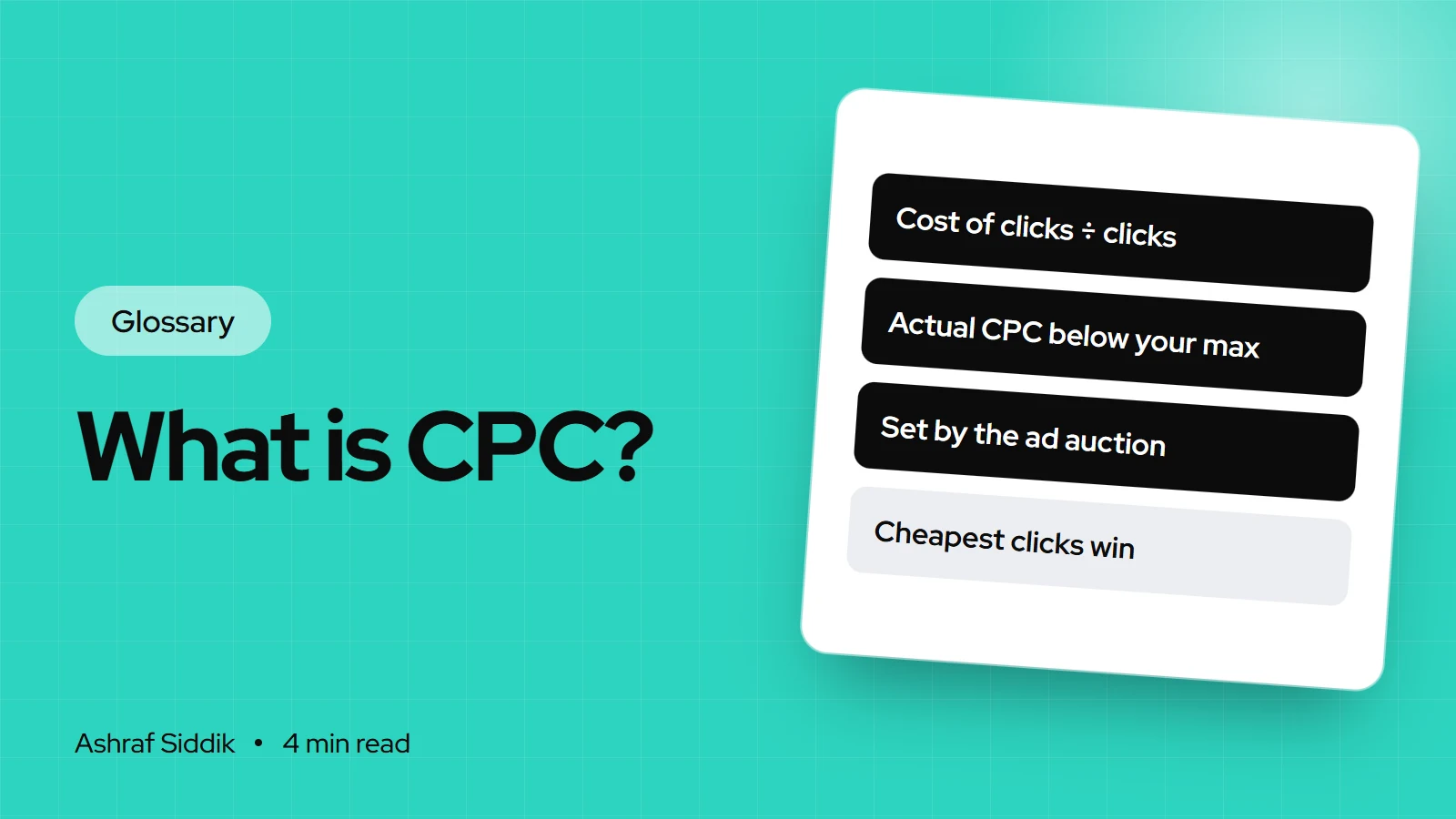
CPC (cost per click) is the amount you pay each time someone clicks your ad. Average CPC is the total cost of your clicks divided by the number of clicks, so $250 spent on 500 clicks is an average CPC of $0.50.
On Google Ads, CPC is also a way of bidding: you pay for each click rather than for impressions. Meta reports CPC as the average cost for each click, counting all clicks. I don't run ad campaigns. I work on the store side, and the store decides how much a click is worth to you. Definitions were checked on Google, Meta and Shopify's help pages on 7 November 2026.
The CPC formula
Average CPC = total cost of clicks ÷ number of clicks
If you know CPM and CTR, you can get CPC without the click count: CPC = CPM ÷ (CTR × 1,000). A $6 CPM with a 1.5% CTR works out to a $0.40 CPC.
Max CPC and actual CPC
- Max CPC: on Google Ads, the highest amount you're willing to pay for a click.
- Actual CPC: the final amount you're charged for a click. Google says you'll typically pay less than your max.
- Average CPC: the average of your actual CPCs over a period, which is the number most reports show.
What you pay comes out of an auction, so it depends on competition for the keyword or audience, the quality and relevance of your ad, and your bid strategy. That is also why nobody can honestly quote you a standard CPC for your niche. Google's Keyword Planner gives bid estimates for specific keywords, which is a better starting point than any average.
How much can you afford per click
Turn the question around. Instead of asking what clicks cost, work out what a click is worth to your store:
Break-even CPC = average order value × conversion rate × gross margin
Here is an illustrative store with a $60 average order value and a 40% gross margin. Only the conversion rate changes.
| Conversion rate | Orders per 100 clicks | Break-even CPC |
|---|---|---|
| 1% | 1 | $0.24 |
| 2% | 2 | $0.48 |
| 3% | 3 | $0.72 |
| 4% | 4 | $0.96 |
At 1% conversion this store can't pay more than $0.24 a click before shipping and fees. At 4% it can pay $0.96. The ads haven't changed. The store has. Raising AOV with bundles or upsells pushes the ceiling up the same way.
Where to find CPC for a Shopify store
- Google Ads: the Avg. CPC column, for campaigns, ad groups, keywords and Shopping products.
- Meta Ads Manager: CPC (all) counts every click. Cost per link click is closer to the cost of a store visit.
- Shopify:
Analytics > Reports > Performance by marketing channelshows ad spend and clicks for channels that report cost data, so you can divide spend by clicks.
Common misconceptions
- "Cheaper clicks are better clicks." A $0.20 click that never buys costs more per order than a $0.80 click that does.
- Comparing Meta all-clicks CPC with Google CPC. Meta's all-clicks figure includes clicks that don't reach your store.
- Setting max CPC from a blog average. Use your own break-even CPC instead.
- Cutting bids when the store is the bottleneck. If clicks land on a slow page or a confusing product page, lower bids just buy fewer of the same wasted visits.
Related terms
- CPM: the cost of 1,000 impressions.
- CTR: the share of impressions that become clicks, which links CPM and CPC.
- Conversion rate and CPA (cost per acquisition): CPC ÷ conversion rate gives your cost per order.
What to do next
- Work out your break-even CPC with your real AOV, conversion rate and margin.
- Compare it with your average CPC for each campaign over the last 30 days.
- Close the gap on the store. My Shopify CRO service starts from $500 and focuses on the pages paid clicks land on. Start with a free store review.
Free tools
Check your own store
Free, no sign-up. Each one runs a part of this guide for you.
Frequently asked questions
What is a cost per click?
Cost per click is the amount an advertiser pays each time someone clicks their ad. Average CPC is total click cost divided by the number of clicks.
How much does a click cost on Google Ads?
There is no fixed price. CPC is set in an auction and depends on competition, ad quality and your bid. Google's Keyword Planner shows bid estimates for specific keywords, which is the most reliable starting point.
What is the difference between max CPC and actual CPC?
Max CPC is the most you're willing to pay for a click. Actual CPC is what you're charged, which Google says is typically less than your max.
What is a good CPC for a Shopify store?
A good CPC is one below your break-even CPC, which is average order value times conversion rate times gross margin. For a store with a $60 AOV, 2% conversion and 40% margin, that is $0.48.
How do I lower my cost per order without lowering CPC?
Raise your conversion rate. Cost per order equals CPC divided by conversion rate, so going from 2% to 3% conversion cuts cost per order by a third at the same CPC.
Sources
- Cost-per-click (CPC): Definition, Google Ads Help
- Average cost-per-click (Avg. CPC): Definition, Google Ads Help
- Ad Account, Insights, Meta for Developers
- Marketing reports, Shopify Help Center
Related services and work

I'm a Shopify developer and CRO specialist. I have built and improved Shopify stores since 2018, completed more than 1,000 projects, and hold a 4.96 average rating across 719 client reviews.
More guides
-
Why Shopify Stores Lose Sales on Mobile: A Practical CRO Checklist
Mobile visitors decide fast, with one thumb and plenty of distractions. Here is how to find the leaks on a Shopify store and fix them in the right order.
-
Shopify CRO Audit Checklist for DTC Brands
The checklist I use to audit DTC Shopify stores, from checking that the data can be trusted to deciding which fixes to ship first.
-
When to Build a Custom Shopify App Instead of Adding Another Subscription
Another subscription is the quickest fix, until you are paying for five apps that still don't match how your business works. Here is how to decide.
-
How to Find Out What Theme a Shopify Store Uses
Every Shopify store names its theme in the page code. Here is where to look, how to read what you find, and what it means for your own theme choice.
-
How to See What Apps a Shopify Store Uses
Apps leave traces in a store's page code: scripts from their own servers, app embed folders and pixel settings. Here is how to read them, and what to do with the list.
-
How to Name a Shopify Store (and Check the Name Is Free)
A store name has to be easy to say, free as a domain and a handle, and clear of other brands. Here is the process I use with clients, and what Shopify lets you change later.