Shopify questionAnswer3 min read
How Much Should a New Shopify Store Spend on Ads?
Spend what you can afford to lose while you learn, sized from your break-even cost per sale. Here's the formula and the store checks to do first.
Key takeaways
- A new store should spend only what it can afford to lose while it learns, sized from its break-even cost per sale.
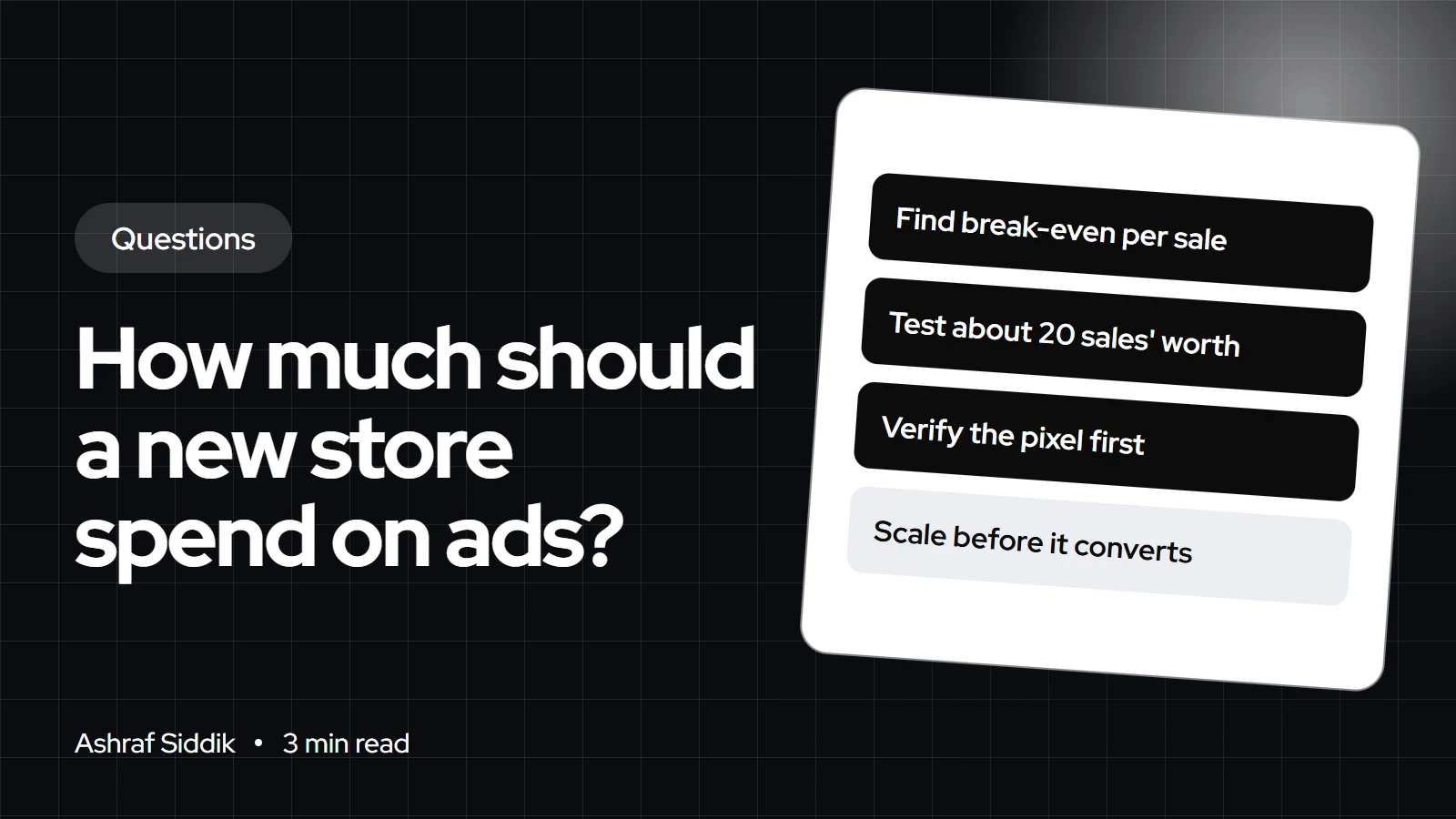
- A useful first test buys about 20 sales at break-even cost. At $25 per sale, that's a $500 test, or roughly $17 a day for a month.
- Meta's budget docs list no minimum. TikTok's help center requires ad group daily budgets above $20 and campaign daily budgets above $50.
- Spend nothing until the pixel is verified and the product page, delivery costs and returns are clear on mobile.
- Who it is for
- New Shopify store owners
- Time needed
- 4 minutes to read
- What you need
- Your product cost and shipping cost
A new Shopify store should spend as much on Facebook ads as it can afford to lose while it learns, and no more. A practical figure is your break-even cost per sale multiplied by about 20, spread over a month. If you can pay $25 for a sale and still break even, plan a $500 test at around $17 a day, then decide on real numbers.
I build and fix Shopify stores and don't run ad accounts. I see new stores that spent their launch budget on ads before the store could convert, so this answer covers the store checks too. Platform figures were checked on 7 November 2026.
Step 1: find your break-even cost per sale
Start with one product. Take the price, then subtract product cost, shipping and payment fees. What's left is the most you can pay for a sale without losing money.
Illustrative break-even on a $45 product
- Costs per order$22.61$15 product, $6 shipping, $1.61 card fee at 2.9% + 30¢.
- Break-even cost per sale$22.39Pay more than this for a sale and you lose money.
For dropshipping, use the supplier price plus shipping. My dropshipping profit calculator does the sum for you.
Step 2: size your first test
| Break-even per sale | Test budget | Per day, 30 days |
|---|---|---|
| $15 | $300 | About $10 |
| $25 | $500 | About $17 |
| $40 | $800 | About $27 |
Twenty sales at break-even is enough to see whether people buy at all and roughly what a sale costs. It's a working rule of mine, not a platform requirement. You won't hit exactly 20; the point is to set the budget before you start, so one bad week doesn't push you into spending more.
Step 3: check platform minimums
- Meta: its budget documentation lists no minimum. On days with better opportunities, it may spend more than your daily budget.
- Google Ads: its daily budget page lists no minimum either. A campaign can spend up to twice its daily budget on one day, with a monthly limit of about 30.4 times.
- TikTok: ad group daily budgets must exceed $20 and campaign daily budgets $50, per its help center. That pushes a TikTok test above most small Meta tests.
Step 4: make sure the store can convert
A new store has no reviews, no repeat customers and no brand recognition. Paid visitors notice. Before you spend, check these:
- Tracking. The Meta pixel is connected through the Facebook & Instagram channel and a test order shows the right value.
- The product page. Clear photos, a specific description, price and delivery cost visible near the button.
- Trust. Contact details, a returns policy and an about page. My guide to building trust in a new Shopify store covers what helps most.
- Mobile. Facebook and Instagram are phone apps first, so test the whole path to checkout on your own phone.
- Delivery times. Long dropshipping delivery times should be stated up front, not discovered after payment.
What to do with the results
If sales cost less than break-even, keep going and raise budgets slowly. If they cost a little more, look at conversion rate and order value before giving up, because a better product page or a bundle can close that gap. My answer on what a good ROAS is shows how to read the numbers, and my guide to Meta ads for Shopify covers the campaign setup.
What to do next
- Calculate break-even for your hero product.
- Set a fixed test budget and an end date.
- Get the store checked first. Ask for a free store review before you spend; my CRO work starts from $500 if fixes are needed.
Free tools
Check your own store
Free, no sign-up. Each one runs a part of this guide for you.
Frequently asked questions
How much should I spend on Facebook ads per month as a new store?
Your break-even cost per sale times about 20, spread over a month. At $25 per sale, that's a $500 test, or about $17 a day.
How much should I spend on Facebook ads for dropshipping?
Use the same formula with your supplier price and shipping as costs. Thin dropshipping margins mean a low break-even cost per sale, so the store must convert well for ads to work.
Is there a minimum budget for Facebook ads?
Meta's budget documentation doesn't list one. The practical minimum is what lets you buy enough sales to judge the test.
Is $5 a day enough for Facebook ads?
It can deliver ads, but at most break-even costs it buys very few sales a month, which makes results hard to read. A smaller number of products with a bigger daily budget teaches you more.
Should a new store advertise before it has reviews?
You can, but expect a lower conversion rate. Add whatever proof you have: clear returns, contact details, real photos, and reviews as soon as the first orders arrive.
What if my first test doesn't make any sales?
Look at the funnel. If people click but don't add to cart, the product page or price is the issue. Fix that before spending more.
Sources
- Budgets, Meta for Developers
- About budgets for ads in TikTok Ads Manager, TikTok Ads Help
- About average daily budgets, Google Ads Help
- Meta pixel, Shopify Help Center
Related services and work

I'm a Shopify developer and CRO specialist. I have built and improved Shopify stores since 2018, completed more than 1,000 projects, and hold a 4.96 average rating across 719 client reviews.
More guides
-
Why Shopify Stores Lose Sales on Mobile: A Practical CRO Checklist
Mobile visitors decide fast, with one thumb and plenty of distractions. Here is how to find the leaks on a Shopify store and fix them in the right order.
-
Shopify CRO Audit Checklist for DTC Brands
The checklist I use to audit DTC Shopify stores, from checking that the data can be trusted to deciding which fixes to ship first.
-
When to Build a Custom Shopify App Instead of Adding Another Subscription
Another subscription is the quickest fix, until you are paying for five apps that still don't match how your business works. Here is how to decide.
-
How to Find Out What Theme a Shopify Store Uses
Every Shopify store names its theme in the page code. Here is where to look, how to read what you find, and what it means for your own theme choice.
-
How to See What Apps a Shopify Store Uses
Apps leave traces in a store's page code: scripts from their own servers, app embed folders and pixel settings. Here is how to read them, and what to do with the list.
-
How to Name a Shopify Store (and Check the Name Is Free)
A store name has to be easy to say, free as a domain and a handle, and clear of other brands. Here is the process I use with clients, and what Shopify lets you change later.