Shopify questionAnswer4 min read
Can I Sell on Shopify as a Sole Trader?
You don't need a limited company to sell on Shopify. Here is when to register with HMRC, what tax a sole trader pays and when a company starts to make sense.
Key takeaways
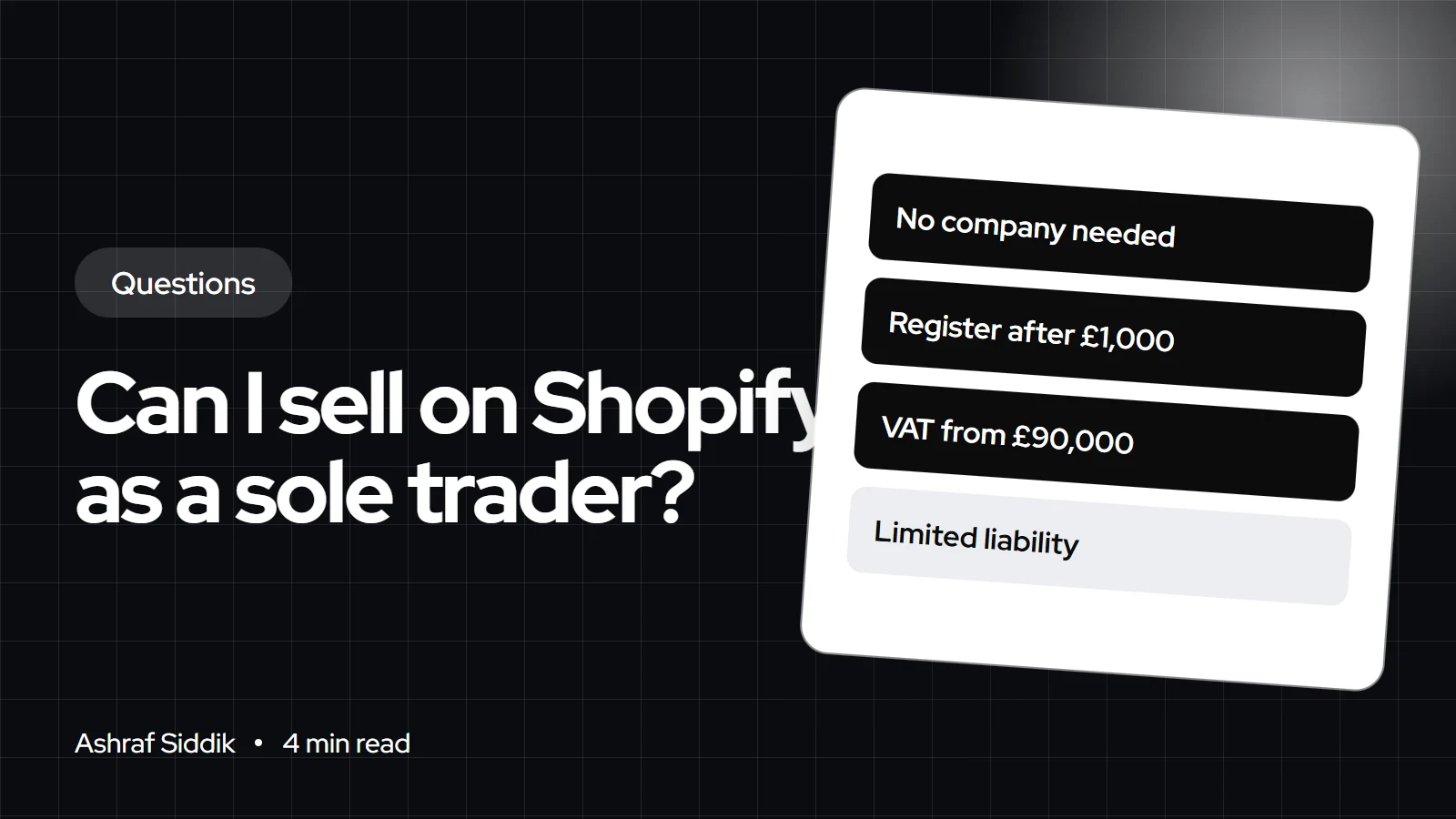
- Yes. You don't need a limited company to open a Shopify store in the UK. Many store owners start as sole traders.
- Gov.uk says you must register for Self Assessment once you earn more than £1,000 from self-employment in a tax year. The deadline is 5 October after the tax year ends.
- As a sole trader you are personally liable for the business's debts, and profit is taxed as your income: 20% basic rate Income Tax plus 6% Class 4 National Insurance on profits between £12,570 and £50,270 in 2026 to 2027.
- VAT is separate: you must register once taxable turnover passes £90,000 in a rolling 12 months.
- Who it is for
- UK sellers starting a Shopify store
- Time needed
- 5 minutes to read
- What you need
- Your expected income and turnover
Yes, you can sell on Shopify as a sole trader. It is the simplest way to run a sole trader online business in the UK: you can start trading straight away, and you register with HMRC for Self Assessment once your self-employed income passes £1,000 in a tax year. The main trade-off is that you are personally liable for the business, so some owners move to a limited company as the store grows.
I work with store owners at every stage, from first product to established brand, and the "do I need a company first" question comes up at almost every launch. The figures below were checked on gov.uk on 7 November 2026. This is general information, not tax or legal advice.
What being a sole trader means for a Shopify store
Gov.uk describes a sole trader as self-employed: you run the business yourself and make all the decisions. There is no separate legal entity. The store's income is your income, and its debts are your debts. You can trade under your own name or a trading name, and you start keeping records from the day you start trading.
Shopify doesn't require a company to open a store. You can sign up as an individual, add your business details, and connect a payment provider. When you set up Shopify Payments, Shopify asks you to verify personal and business information.
Registering with HMRC
- Trade first if you like. Gov.uk says you can start trading without registering.
- Register once you pass £1,000. If you earn more than £1,000 from self-employment in a tax year, register for Self Assessment. You can register earlier.
- Meet the deadline. Register by 5 October after the end of the tax year you need to report. For the 2025 to 2026 tax year, that date was 5 October 2026. Late registration can bring a penalty.
- File and pay. HMRC works out your Income Tax and National Insurance from the profits on your return.
What you pay as a sole trader (2026 to 2027)
| Profit band | Income Tax | Class 4 NI |
|---|---|---|
| Up to £12,570 | 0% | 0% |
| £12,571 to £50,270 | 20% | 6% |
| £50,271 to £125,140 | 40% | 2% |
| Over £125,140 | 45% | 2% |
These are the gov.uk rates for England, Wales and Northern Ireland. Scotland has different Income Tax bands. The personal allowance shrinks by £1 for every £2 of income above £100,000. Class 2 National Insurance is treated as paid once profits reach £7,105; below that, you can pay £3.65 a week voluntarily to protect your State Pension record.
Making Tax Digital and VAT
Making Tax Digital for Income Tax: sole traders with qualifying income over £50,000 had to start using it from 6 April 2026. The threshold drops to £30,000 from 6 April 2027 and £20,000 from 6 April 2028. Qualifying income is based on turnover, not profit, so a store can pass these lines quickly. You'll need compatible software and quarterly updates.
VAT: you must register if your taxable turnover over the last 12 months goes above £90,000, or you expect it to within the next 30 days. You can register voluntarily before that. My VAT guide for Shopify stores covers what changes in your Shopify tax settings.
When to consider a limited company
The main reasons store owners switch are liability and tax at higher profit levels. A company separates business debts from your personal assets, and once profits reach the higher-rate band the tax comparison can change, so ask an accountant to run both options with your numbers. A company also brings filing duties at Companies House and more admin. My guide to sole trader vs limited company for online sellers sets out the trade-offs side by side.
Other countries
US: the IRS calls this a sole proprietorship. Profit is reported on Schedule C and self-employment tax on Schedule SE, alongside Form 1040.
Netherlands: the equivalent is an eenmanszaak. Business.gov.nl says it has no legal personality, you are personally liable, and you must register with the KVK.
Australia: business.gov.au says a sole trader can use their individual tax file number to lodge tax returns, and has unlimited personal liability.
What to do next
- Open a separate bank account for the store, even though it isn't legally required. It makes records and payouts far easier.
- Register for Self Assessment as soon as you expect to pass £1,000 in a tax year.
- Track turnover monthly against the £90,000 VAT threshold and the Making Tax Digital limits.
- Set up the store properly from day one, using my guide to starting a Shopify store, or get a build from my Shopify development service, which starts from $300 with a fixed quote.
Free tools
Check your own store
Free, no sign-up. Each one runs a part of this guide for you.
Frequently asked questions
Do I need a limited company to sell on Shopify in the UK?
No. You can sell on Shopify as a sole trader. Gov.uk says you can start trading without registering, and must register for Self Assessment once you earn more than £1,000 from self-employment in a tax year.
When do I need to tell HMRC about my Shopify store?
Register for Self Assessment by 5 October after the end of the tax year in which your self-employed income went over £1,000. Late registration can lead to a penalty.
Do I pay tax on Shopify sales or profit?
On profit. Sales minus allowable expenses such as stock, Shopify fees and marketing gives your taxable profit. If you use the £1,000 trading allowance instead, you can't claim expenses.
Does a sole trader Shopify store need to charge VAT?
Only once you register. Registration is required when taxable turnover over the last 12 months goes above £90,000, or you expect it to within 30 days. You can register voluntarily earlier.
Can I use a trading name on Shopify as a sole trader?
Yes. Gov.uk says you can trade under your own name or a trading name. Check the naming rules on gov.uk before you choose, and make sure your store policies show your legal name and address.
Does Making Tax Digital apply to Shopify sellers?
Yes, once qualifying income passes the threshold: £50,000 from 6 April 2026, £30,000 from 6 April 2027 and £20,000 from 6 April 2028. Qualifying income is based on turnover, so check your sales figures, not just profit.
Sources
- Set up as a sole trader, GOV.UK
- Register for Self Assessment, GOV.UK
- Income Tax rates and Personal Allowances, GOV.UK
- Self-employed National Insurance rates, GOV.UK
- Check if you're eligible for Making Tax Digital for Income Tax, HM Revenue & Customs, GOV.UK
- Expenses if you're self-employed, GOV.UK
Related services and work

I'm a Shopify developer and CRO specialist. I have built and improved Shopify stores since 2018, completed more than 1,000 projects, and hold a 4.96 average rating across 719 client reviews.
More guides
-
Why Shopify Stores Lose Sales on Mobile: A Practical CRO Checklist
Mobile visitors decide fast, with one thumb and plenty of distractions. Here is how to find the leaks on a Shopify store and fix them in the right order.
-
Shopify CRO Audit Checklist for DTC Brands
The checklist I use to audit DTC Shopify stores, from checking that the data can be trusted to deciding which fixes to ship first.
-
When to Build a Custom Shopify App Instead of Adding Another Subscription
Another subscription is the quickest fix, until you are paying for five apps that still don't match how your business works. Here is how to decide.
-
How to Find Out What Theme a Shopify Store Uses
Every Shopify store names its theme in the page code. Here is where to look, how to read what you find, and what it means for your own theme choice.
-
How to See What Apps a Shopify Store Uses
Apps leave traces in a store's page code: scripts from their own servers, app embed folders and pixel settings. Here is how to read them, and what to do with the list.
-
How to Name a Shopify Store (and Check the Name Is Free)
A store name has to be easy to say, free as a domain and a handle, and clear of other brands. Here is the process I use with clients, and what Shopify lets you change later.