Shopify guideGuide10 min read
Sole Trader vs Limited Company: Which Is Better for Selling Online?
Going limited no longer saves tax for every small store. Here are the 2026 to 2027 rates, a worked example at two profit levels and the exact steps to switch your Shopify store to a company.
Key takeaways
- A sole trader pays Income Tax and Class 4 National Insurance on all profit. A limited company pays Corporation Tax, then you pay tax again on the salary and dividends you take out.
- At 2026 to 2027 rates, my rough sums show a sole trader keeping more than a one-director company at both £50,000 and £100,000 profit, if every pound is taken out.
- A company starts to pay off when you leave profit in the business to fund stock and growth, need limited liability, or sell to buyers who only deal with companies.
- Switching a Shopify store to a company means adding a new business entity in your settings, and Shopify Payments must be deactivated before you change the entity.
- Who it is for
- UK store owners deciding how to trade
- Time needed
- An hour with your numbers, then an accountant
- What you need
- Your yearly profit and how much you take home
Most UK store owners I work with start as sole traders, and the limited company question arrives the first year profits look serious. Usually a friend has said "go limited, it saves tax". That used to be close to true for a lot of small sellers. With employer National Insurance at 15% and dividend tax rates higher from April 2026, it is much less true now, and the answer depends on how much profit you make and how much of it you need to take home.
This guide gives you the rates, a worked example at two profit levels, the setup steps for each structure and what changes inside Shopify when you switch. Every rate below comes from GOV.UK, as checked on 7 November 2026, for the 2026 to 2027 tax year in England, Wales and Northern Ireland. Scottish Income Tax bands are different.
The short answer
| Your situation | Better fit | Why |
|---|---|---|
| Testing a store, profit under £20,000 | Sole trader | Free to start, one tax return, no company filings |
| Profit of £30,000 to £100,000, all taken home | Sole trader | Usually less tax in total at 2026 to 2027 rates |
| Profit reinvested in stock and growth | Ltd company | Retained profit pays 19% to 25% Corporation Tax, not 40% |
| Product liability, leases or big supplier credit | Ltd company | Company debts generally stay with the company |
| Wholesale buyers who only trade with companies | Ltd company | Some retailers and marketplaces ask for one |
What actually changes between the two
As a sole trader, you and the business are the same legal person. GOV.UK puts it plainly: you have unlimited liability, so you are personally responsible for the business's debts. You register for Self Assessment, keep records and pay tax on the profit, whether you take it out of the bank or not.
A limited company is a separate legal person. It owns the Shopify store, the stock and the bank account. You are a director, and usually the only shareholder. The company pays Corporation Tax on its profit, and you pay personal tax only on what you take out, as salary or dividends.
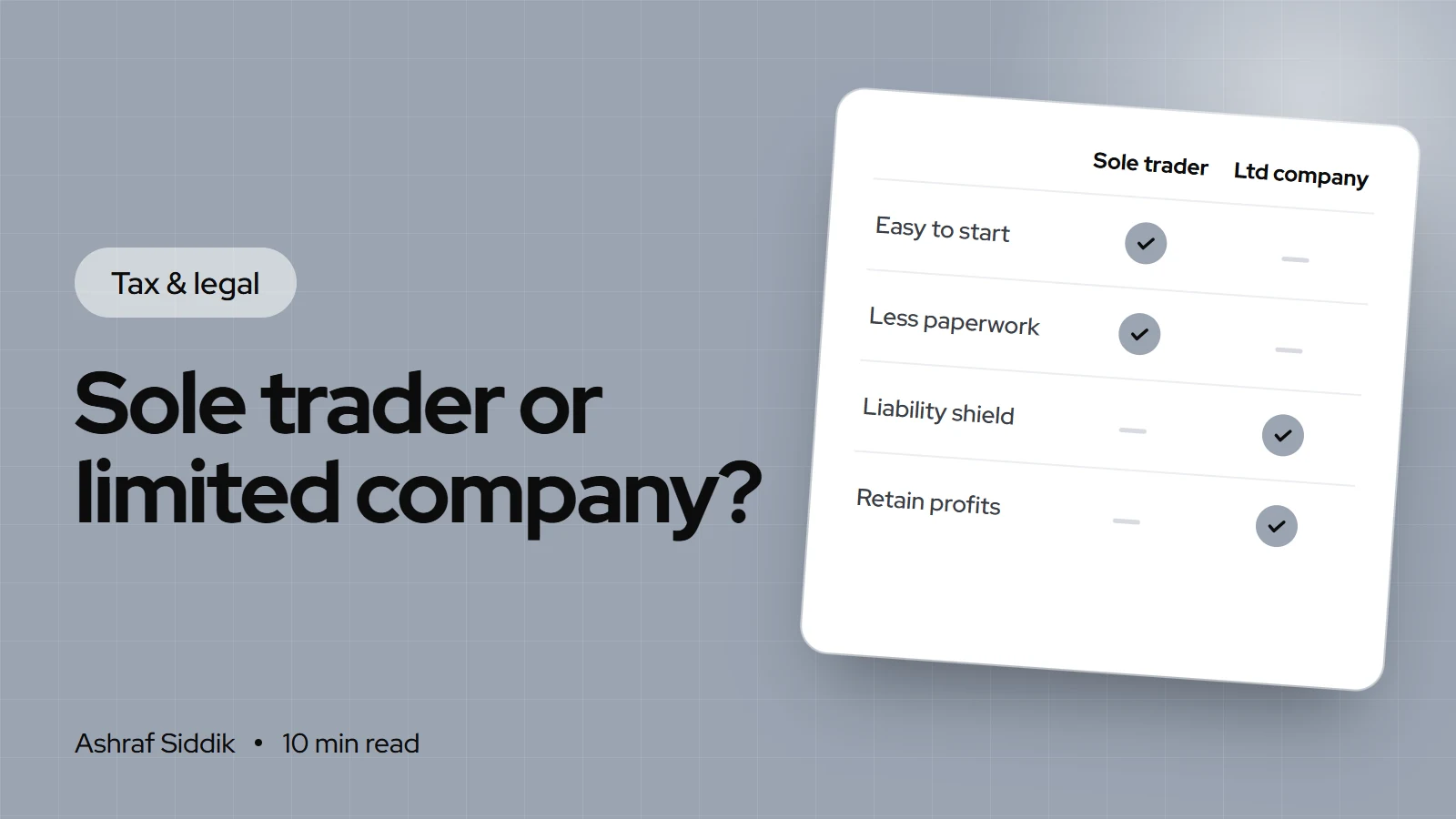
| Area | Sole trader | Limited company |
|---|---|---|
| Setup | Free, register for Self Assessment | £100 online at Companies House |
| Liability | Unlimited, personal | Generally limited to the company |
| Tax on profit | Income Tax and Class 4 NI | Corporation Tax, then tax on pay and dividends |
| Yearly filings | One Self Assessment return | Accounts, Company Tax Return, confirmation statement, payroll |
| Accounts deadline | 31 January after the tax year | 9 months after year end to Companies House |
The admin is the cost people underestimate. A director stays legally responsible for the company's records, accounts and tax returns even when an accountant does the work, and most owners do pay an accountant to file them.
The 2026 to 2027 rates you need
| Tax | Band | Rate |
|---|---|---|
| Income Tax | £12,571 to £50,270 | 20% |
| Income Tax | £50,271 to £125,140 | 40% |
| Class 4 NI (sole trader) | £12,570 to £50,270, then above | 6%, then 2% |
| Corporation Tax | Profit up to £50,000 | 19% |
| Corporation Tax | Profit over £250,000 | 25%, with marginal relief between |
| Dividend tax | Basic and higher rate | 10.75% and 35.75% |
| Employer NI | Salary above £5,000 | 15% |
The personal allowance is £12,570, and it shrinks by £1 for every £2 of income above £100,000. Everyone also gets a £500 dividend allowance. Class 2 National Insurance is no longer a bill for most sole traders: if profits are £7,105 or more, it is treated as paid.
The rule that hurts small companies most is in the Employment Allowance. It cuts employer National Insurance by up to £10,500 a year, but a company whose only director is also the only employee paying secondary Class 1 contributions can't claim it. Most one-person store companies are in exactly that position.
Worked example: £50,000 and £100,000 profit
This is the sum the "sole trader vs limited company calculator" searches are after. I compared a sole trader with a one-director company that pays a £12,570 salary and takes the rest as dividends. Profit means what is left after stock, Shopify fees, apps, postage and other costs.
Total tax and NI if all profit is taken out, 2026 to 2027
- Sole trader, £50,000£9,732£7,486 Income Tax and £2,246 Class 4 NI. You keep £40,268.
- Ltd company, £50,000£11,138£1,136 employer NI, £6,896 Corporation Tax, £3,107 dividend tax. You keep £38,862.
- Sole trader, £100,000£30,689£27,432 Income Tax and £3,257 Class 4 NI. You keep £69,311.
- Ltd company, £100,000£34,790£1,136 employer NI, £19,118 Corporation Tax, £14,537 dividend tax. You keep £65,210.
So if you need every pound of profit to live on, the company costs more in tax at both levels, before you add an accountant's fee. That surprises a lot of people, because the old advice was built on lower dividend rates and lower employer National Insurance.
The picture changes when you leave money in the business. Take the £100,000 company again, but this time the owner takes only enough dividend to stay in the basic rate band (£37,700 on top of the salary). They pay £24,253 in tax so far and keep £46,271 personally, and the company keeps £29,476 to spend on stock, a new theme or ads. As a sole trader, the same £100,000 is taxed at £30,689 whether the money stays in the business or not. The retained profit will be taxed again when it is eventually paid out, but in the meantime it is working in the store.
Before you run your own numbers, work out your real profit. The profit margin calculator helps per product, and Shopify fees explained covers the costs people forget, such as currency conversion and app subscriptions.
How to start as a sole trader
- Check you need to register. You must register for Self Assessment once you earn more than £1,000 from self-employment in a tax year (6 April to 5 April). Below that, you can still register early.
- Register by the deadline. For income in the 2025 to 2026 tax year, HMRC's deadline was 5 October 2026. The same 5 October date applies each year for the tax year that has just ended.
- Keep records from day one. Save every Shopify payout report, supplier invoice and postage receipt. Your accounts are built from them.
- Watch Making Tax Digital. Sole traders with qualifying income over £50,000 have had to use it since 6 April 2026. The threshold drops to £30,000 from 6 April 2027 and £20,000 from 6 April 2028. Qualifying income means turnover, not profit, so a store with modest profit can still be caught.
- Watch the VAT threshold. Register for VAT if taxable turnover in the last 12 months goes over £90,000, or you expect to pass it in the next 30 days. The threshold is the same for both structures.
How to set up a limited company
- Verify your identity. Each director may need to verify through GOV.UK One Login first, and you need every director's personal code to register.
- Register with Companies House. Online registration costs £100 and is usually done within 24 hours. A postal application costs £124 and takes 8 to 10 days.
- Open a business bank account in the company's name. Your Shopify payouts will need to land here once the store moves.
- Register for Corporation Tax and payroll. Paying yourself a salary means running payroll, even when you're the only person on it.
- Diary the deadlines. Accounts go to Companies House 9 months after the financial year ends. Corporation Tax is due 9 months and 1 day after the accounting period ends, and the Company Tax Return 12 months after it.
- Keep company money separate. Money you take out that isn't salary, dividends or expenses is a director's loan, and it has its own tax rules.
What changes in Shopify when you switch
This is the part accountants rarely mention, and where I see stores lose a week of payouts. Shopify treats a sole trader and a company as different business entities, and you can't edit one into the other. Shopify's help center says you can't change the business type, country or person on an individual or sole proprietor entity. You add a new entity instead.
- Plan a quiet day. Before you change your business entity, Shopify requires you to deactivate financial services, including Shopify Payments. Only the store owner can do that. Pick a low-sales day and tell customers PayPal or another method will be available.
- Add the company. Go to
Settings > Organizationand add a new business entity in the Business entities section. The legal name must match your Companies House record exactly. - Switch the store's entity. Go to
Settings > General, open the menu in Business details and choose Switch. - Set up Shopify Payments again under
Settings > Payments, with the company bank account and director details. - Update everything with your name on it. Billing details, VAT number in tax settings, your contact information policy, invoices, email footers and app accounts.
Don't archive the old entity while it still has a pending payout. Shopify won't let you archive an entity that is in use or waiting on a payout, and you want those last sole trader payouts to land cleanly.
Common mistakes
- Comparing tax on revenue, not profit. A store taking £150,000 can easily have under £40,000 profit after stock, fees and postage.
- Forgetting employer NI. At 15% on salary above £5,000, with no Employment Allowance for a one-director company, it changes the best salary level.
- Treating the company bank account as your own. Transfers that aren't salary or dividends become a director's loan, which has to be recorded and can be taxed.
- Switching the Shopify entity mid-campaign. Payments go off while you swap entities, so do it outside sales and launches.
- Ignoring turnover thresholds. VAT and Making Tax Digital both work on turnover, so a busy, low-margin store can cross them early.
Decision checklist
- I know my real yearly profit, after every cost, not just my Shopify sales total.
- I know how much of that profit I need to take home each year.
- I have asked whether my products carry liability risk that a company would help contain.
- I have checked whether my turnover is near £90,000 (VAT) or the Making Tax Digital thresholds.
- I have had an accountant run both structures with my real numbers and their own fee included.
- If switching, I have picked a quiet day to move Shopify Payments to the new entity.
Next steps
Work out your profit first, then talk to an accountant with the figures in hand. If you decide to incorporate, plan the Shopify switch as a small project: new entity, new payments setup, updated policies and invoices, all done on one quiet day. If you're also starting to sell into Europe, read how to set up taxes in Shopify for the UK and EU next.
If you'd like help moving the store across, or want someone to check what else needs updating, I work with UK store owners as a Shopify developer in the UK, and a free store review is a good place to start.
Free tools
Check your own store
Free, no sign-up. Each one runs a part of this guide for you.
Frequently asked questions
Is a limited company cheaper than being a sole trader?
Not always. At 2026 to 2027 rates, a one-director company that takes all its profit out pays more tax in total than a sole trader at both £50,000 and £100,000 profit in my worked example. A company becomes cheaper when you leave profit in the business, because that profit is taxed at Corporation Tax rates rather than your personal rate.
How much does it cost to set up a limited company in the UK?
Registering online with Companies House costs £100 and usually takes 24 hours. Registering by post costs £124 and takes 8 to 10 days. You will also have yearly costs, such as filing a confirmation statement and, in most cases, an accountant.
When do I have to register as a sole trader?
You must register for Self Assessment once you earn more than £1,000 from self-employment in a tax year. The deadline to tell HMRC is 5 October after the end of the tax year in which you started.
Can I change my Shopify store from a sole trader to a company?
Yes, but not by editing your existing details. Shopify doesn't let you change the business type of a sole proprietor entity, so you add a new business entity under Settings, switch the store to it and set up Shopify Payments again. Shopify Payments must be deactivated before you change the entity.
What salary should a limited company director take?
It depends on your situation, which is why an accountant should set it. In my example I used £12,570, the personal allowance and the primary threshold for employee National Insurance. Employer National Insurance is 15% above £5,000, and a company whose sole director is its only employee can't claim the Employment Allowance.
Is this tax advice?
No. This is general information based on GOV.UK rates for 2026 to 2027 in England, Wales and Northern Ireland. Your other income, pension, location and plans change the result, so check your exact case with an accountant.
Sources
- Income Tax rates and Personal Allowances, GOV.UK
- Self-employed National Insurance rates, GOV.UK
- Rates and allowances: Corporation Tax, GOV.UK
- Tax on dividends, GOV.UK
- Register your company, GOV.UK
- Managing business entities, Shopify Help Center
Related services and work

I'm a Shopify developer and CRO specialist. I have built and improved Shopify stores since 2018, completed more than 1,000 projects, and hold a 4.96 average rating across 719 client reviews.
More guides
-
How to Write a Returns Policy for Your Online Store (UK Template)
Here is a returns policy template you can adapt for a UK online store, a no-returns version for personalized items, and the legal minimum every line has to respect. It ends with the exact Shopify settings that enforce it.
-
Can I Sell on Shopify as a Sole Trader?
You don't need a limited company to sell on Shopify. Here is when to register with HMRC, what tax a sole trader pays and when a company starts to make sense.
-
UK Online Store Legal Checklist: Distance Selling Regulations
The distance selling regulations decide what you must tell shoppers, how long they get to cancel and how fast you refund. Here they are as a checklist you can tick off against your store, with the Shopify setting for every rule.
-
Consumer Rights Act Returns: The Rules for UK Online Stores
UK shoppers can cancel online orders within 14 days and reject faulty goods within 30. Here are both sets of rules in plain English, and the exact Shopify settings that keep your store on the right side of them.