Shopify questionAnswer4 min read
Can a New Shopify Store Rank Without Backlinks?
A new store with no links can still rank, but not for everything. Here is which searches are realistic, what carries a store before links arrive, and how to earn them without risk.
Key takeaways
- A new Shopify store can rank without backlinks for specific, low-competition searches: its brand name, exact product names and long-tail product queries.
- For competitive category searches, links still matter. Google says PageRank, which looks at how pages link to each other, remains one of its core ranking systems.
- Google mainly finds new pages through links, but Shopify's automatic sitemap lets it discover your pages before anyone links to you.
- Buying links to manipulate rankings breaks Google's spam policies. Earn them from suppliers, partners, press and useful content instead.
- Who it is for
- New Shopify store owners
- Time needed
- 5 minutes to read
- What you need
- A verified Search Console property
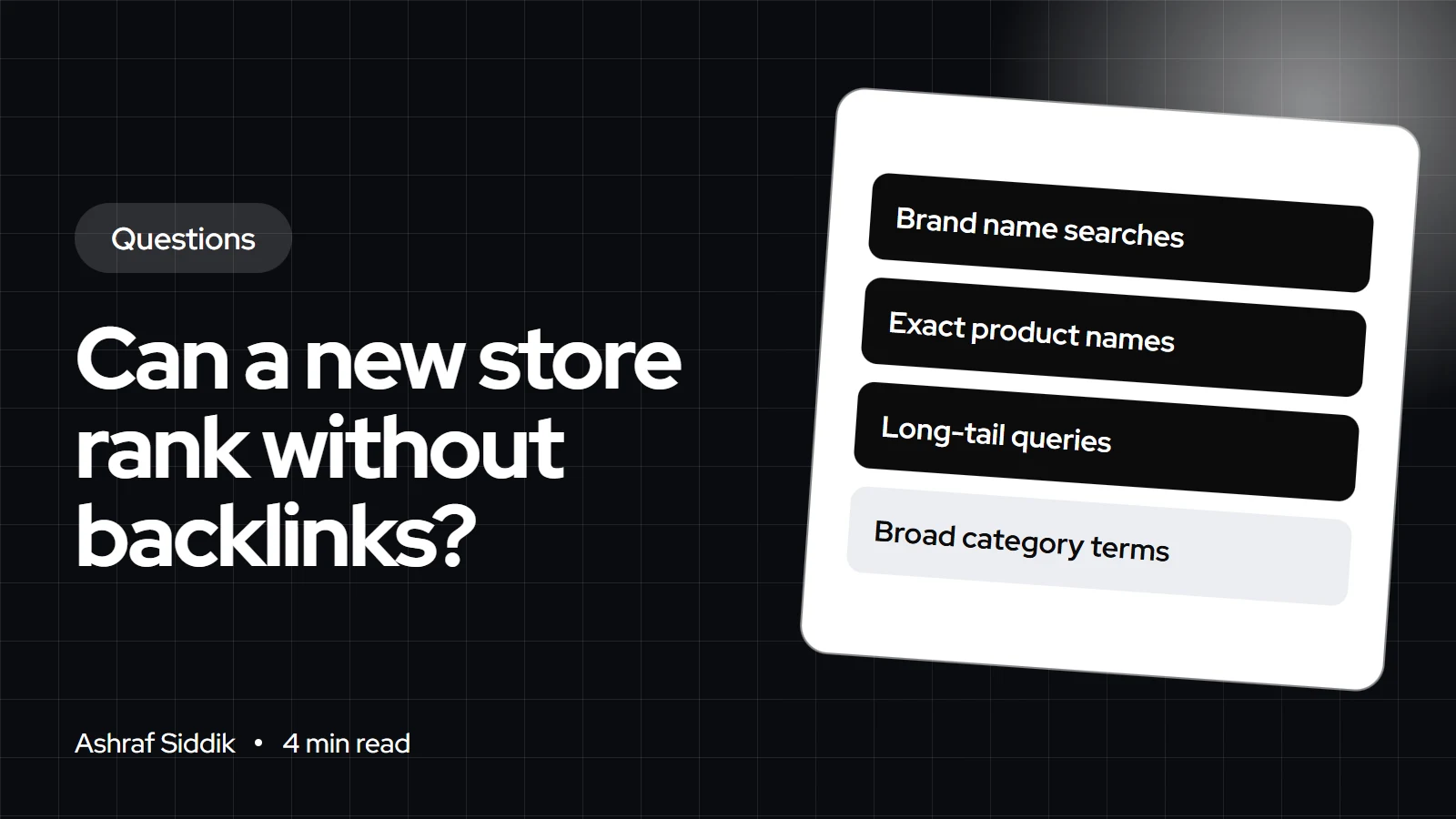
Yes, a new Shopify store can rank without backlinks, but mostly for specific searches with little competition, such as its own brand name, exact product or model names and detailed long-tail queries. For broad, competitive terms, links from other sites still matter, because Google uses links both to discover pages and to judge what they're about. The realistic plan is to win the long tail with strong pages first and earn links as you grow.
What Google says about links
Google's ranking systems guide says it has systems that understand how pages link to each other to work out what pages are about, and names PageRank as one of its core ranking systems. Its SEO Starter Guide adds that Google primarily finds pages through links from pages it has already crawled.
Links aren't the only route in, though. The same guide describes a sitemap as a file listing the URLs you care about, and Shopify generates sitemap.xml automatically and updates it whenever you add products, collections, pages or posts. Submit it in Search Console and Google can find your pages without a single external link.
What a store can rank for without links
| Search type | Without links | Example |
|---|---|---|
| Your brand name | Very likely | "Northfield Candles" |
| Exact product or model | Often | "Aeropress Go travel kit" |
| Detailed long tail | Possible | "vegan leather dog collar small" |
| Questions and how-tos | Possible | "how to clean a cast iron pan" |
| Broad category terms | Unlikely | "dog collars" |
These are my estimates from working on new stores, not rules. The pattern holds because fewer, weaker pages compete for specific searches, so content quality can carry a page that has no links pointing at it.
What carries a new store before links arrive
- Unique product copy. Manufacturer descriptions appear on dozens of sites. Your own detail on sizing, materials and use cases gives Google a reason to rank you.
- Collection pages with real copy. A short intro and helpful detail below the grid lets collections compete for mid-length searches. My guide to collection page SEO shows the structure.
- Titles that match searches. Write each search engine listing title around the search you want, not your internal product name.
- Clean technical basics. Shopify adds canonical tags, product schema through themes and SSL by default, so keep apps and theme edits from breaking them.
- Fast pages. Remove unused apps and heavy scripts, which slow most new stores I see.
Internal links: the links you control
Links between your own pages help Google find and understand them, and you can add them today. Link collections from the main menu, link related products from each product page, and link blog posts to the products they discuss. A product buried four clicks deep with no internal links is hard for Google to value, even with perfect copy.
How to earn links safely
Google's spam policies define link spam as creating links mainly to manipulate rankings, and name buying or selling links for ranking purposes and excessive link exchanges as examples. Avoid both. These sources are legitimate and suit new stores:
- Suppliers and brands you stock, many of which list stockists.
- Local press and business groups in your town or region.
- Partners and collaborations, such as a maker you co-design with.
- Useful guides that other sites want to cite.
- Podcasts and interviews about how you started.
Local signals by market
Stores selling in one country can start with local links that big competitors overlook. UK stores can use local business directories, trade associations and regional press. Australian stores can do the same with state-level business groups and local media. Dutch stores need Dutch-language pages and links from Dutch sites to compete on Dutch searches. In the US, city and state press and niche communities are often easier to win than national coverage. A country domain such as .co.uk, .com.au or .nl also tells shoppers where you trade.
What to do next
- Submit your sitemap and confirm pages are indexed in Search Console.
- List 20 long-tail searches your products answer, and make sure a page targets each one.
- Rewrite your top product pages using my product page SEO guide.
- Set expectations. Read how long Shopify SEO takes to work before judging results.
- Get a plan. My Shopify SEO service starts from $200 if you'd like help choosing targets.
Free tools
Check your own store
Free, no sign-up. Each one runs a part of this guide for you.
Frequently asked questions
Do I need backlinks for SEO?
Not for every search. New stores can rank for brand names, exact products and long-tail queries on content quality alone. For competitive searches, links from other sites are usually needed, since Google still uses links in ranking.
How can Google find my store without backlinks?
Through your sitemap. Shopify generates sitemap.xml automatically, and submitting it in Google Search Console tells Google about your pages without any external links.
Is it safe to buy backlinks for a Shopify store?
No. Google's spam policies name buying or selling links for ranking purposes as link spam. Paid links can be ignored or lead to a manual action, which costs more than it gains.
How many backlinks does a new store need?
There's no set number. A few relevant links from real sites, such as suppliers, partners and local press, are worth more than many low-quality ones.
Do internal links count as backlinks?
No, backlinks come from other sites. Internal links still help Google find your pages and understand which ones matter most, and you control them fully.
Can social media links help a new store rank?
Social posts help people find you and can lead to real links from sites that notice you. Treat them as a way to get attention, not as a direct ranking tool.
Sources
- SEO Starter Guide, Google Search Central
- A guide to Google Search ranking systems, Google Search Central
- Spam policies for Google web search, Google Search Central
- Finding and submitting your sitemap, Shopify Help Center
- SEO overview, Shopify Help Center
Related services and work

I'm a Shopify developer and CRO specialist. I have built and improved Shopify stores since 2018, completed more than 1,000 projects, and hold a 4.96 average rating across 719 client reviews.
More guides
-
Why Shopify Stores Lose Sales on Mobile: A Practical CRO Checklist
Mobile visitors decide fast, with one thumb and plenty of distractions. Here is how to find the leaks on a Shopify store and fix them in the right order.
-
Shopify CRO Audit Checklist for DTC Brands
The checklist I use to audit DTC Shopify stores, from checking that the data can be trusted to deciding which fixes to ship first.
-
When to Build a Custom Shopify App Instead of Adding Another Subscription
Another subscription is the quickest fix, until you are paying for five apps that still don't match how your business works. Here is how to decide.
-
How to Find Out What Theme a Shopify Store Uses
Every Shopify store names its theme in the page code. Here is where to look, how to read what you find, and what it means for your own theme choice.
-
How to See What Apps a Shopify Store Uses
Apps leave traces in a store's page code: scripts from their own servers, app embed folders and pixel settings. Here is how to read them, and what to do with the list.
-
How to Name a Shopify Store (and Check the Name Is Free)
A store name has to be easy to say, free as a domain and a handle, and clear of other brands. Here is the process I use with clients, and what Shopify lets you change later.