Shopify guideGuide8 min read
How to Choose Eco-Friendly Packaging for Your Brand
Good eco friendly packaging protects the product with less material, and makes claims you can back up. Here is how to choose it, word it and set it up in your store.
Key takeaways
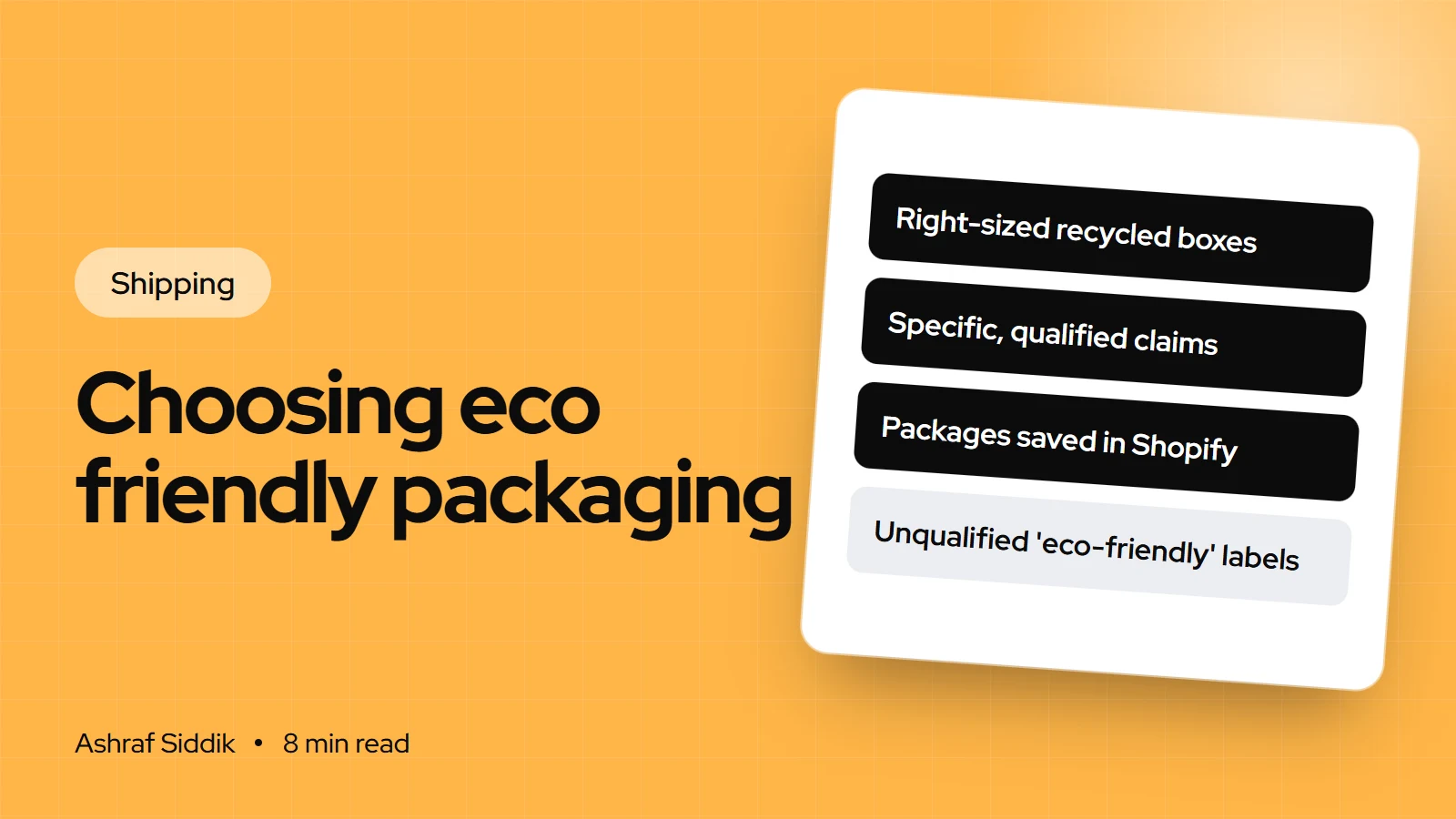
- The greenest package is usually the smallest one that protects the product. Right-sizing cuts material, damage and shipping cost at the same time.
- In the US, the FTC's Green Guides say you shouldn't make unqualified general claims like "eco-friendly", and you can only call packaging recyclable without qualification if recycling is available to at least 60% of the people you sell to.
- "Compostable" mailers often need an industrial facility. If they can't be composted at home, the FTC expects you to say so clearly.
- Shopify helps on the operations side: saved packages and packed product sizes keep shipping rates accurate, and the Planet app can make shipments carbon neutral.
- Who it is for
- Brands choosing or changing packaging
- Time needed
- A week or two with samples
- What you need
- Your product sizes, weights and order data
Your shipping box is the one piece of your brand every customer holds in their hands. That makes packaging a real buying decision for a small business, not just a supplies order. Customers notice plastic fill and oversized boxes, regulators notice vague green claims, and carriers charge you for every extra centimeter of box.
This guide is a practical way to choose eco friendly packaging for a Shopify brand: the materials worth considering, the claims you can and can't print, how to vet suppliers, and how to set up packages in Shopify so your rates stay right. Rules and figures come from the FTC, the US EPA, certification bodies and Shopify's help center as I checked them on 7 November 2026. Nothing here is legal advice.
Why packaging choices matter
Packaging is a big part of what households throw away. The EPA's most recent product-level figures, for 2018, put containers and packaging at more than a quarter of all US municipal solid waste.
US containers and packaging, 2018
- Generated82.2M tonsContainers and packaging in US municipal waste.
- Share of waste28.1%Of all US municipal solid waste generated.
- Recycled overall53.9%Recycling rate for all containers and packaging.
- Corrugated boxes96.5%Recycling rate for corrugated cardboard boxes.
That last number is the useful one for a small brand. Corrugated cardboard is already recycled at a very high rate in the US, so a plain, right-sized cardboard box is often a stronger choice than a novel material your customers don't know how to dispose of.
Common eco friendly packaging options
No material wins on every count. Match the material to the product and to what your customers can actually do with it afterwards.
| Option | Good for | Watch out for |
|---|---|---|
| Recycled corrugated box | Fragile, heavy or boxed products | Oversizing, and plastic tape or fill inside |
| Paper mailer or padded paper bag | Clothing, books, flat items | Less protection, and moisture |
| Compostable mailer | Soft goods for eco-focused buyers | Often needs industrial composting |
| Recycled-content poly mailer | Clothing that must stay dry | Curbside recycling is often not accepted |
| Paper fill and paper tape | Void fill and sealing | Using more than the product needs |
| Reusable or returnable packaging | Repeat orders, subscriptions | Return logistics and cost per cycle |
Small businesses often get the best result from a short list: one or two box sizes, one mailer, paper fill and paper tape. Fewer formats mean bigger orders per item, simpler packing and fewer shipping rate errors.
What you can claim, and how to say it
This is where well-meaning brands get into trouble. In the US, the FTC's Green Guides set out how environmental marketing claims are read and what backs them up. Three rules matter most for packaging:
- General claims. The Guides say marketers shouldn't make unqualified general environmental claims such as "eco-friendly" or "green". Qualify them with the specific benefit, such as "box made from 100% recycled cardboard".
- Recyclable. You can call packaging recyclable without qualification only when recycling facilities are available to a substantial majority, at least 60%, of the consumers or communities where it's sold. Below that, qualify the claim.
- Compostable. You need competent and reliable scientific evidence that all the materials break down into usable compost in about the same time as the materials they're composted with. If the item can't be composted safely at home, or composting facilities aren't available to a substantial majority, say so clearly.
The FTC has been reviewing the Green Guides since 2022, including a workshop on recyclable claims in 2023, so check the current version before you print boxes in bulk. Third-party labels help with the details: How2Recycle provides on-package disposal instructions based on a recyclability assessment, BPI certifies compostable products to ASTM standards in North America, and FSC labels show wood-based material as FSC 100%, FSC Recycled or FSC Mix. Use those marks only if your supplier is certified or licensed to let you.
How to choose packaging, step by step
- List what you ship. Pull your top 20 products by orders and note size, weight and fragility. Check which products arrive damaged, from returns and complaints.
- Group products into a few box sizes. Aim for the fewest sizes that fit most orders snugly. Every centimeter of empty space costs material, void fill and often postage.
- Pick a material per group. Use the table above. Fragile goods get a box, soft goods a mailer.
- Decide what you'll claim. Write the exact wording now, and ask your supplier for the evidence behind it: recycled content certificates, compostability certification or FSC certification details.
- Order samples and test. Pack real orders, drop-test them and send a few to yourself and friends by your usual carrier.
- Price it per order. Add packaging cost to your product margin, not just the shipping line, and check the result with the profit margin calculator.
- Set it up in Shopify. Save the final boxes as packages, so checkout rates and labels use the right sizes (see below).
- Tell customers how to dispose of it. One line on the box or insert does more than a paragraph on your About page.
How to vet eco friendly packaging companies
Search results for eco friendly packaging supplies are full of similar-looking suppliers. These questions separate them quickly:
- Evidence. Can they share the certificate or test report behind each claim, in their name, for the exact product?
- Minimum order quantity. Custom eco friendly packaging with your logo often comes with a high minimum. Stock sizes with a printed sticker or stamp can be the better start for a small business.
- Lead times and restocks. How long a reorder takes, and whether sizes stay in stock.
- Print and inks. Heavy coatings and laminates can make a recyclable box harder to recycle. Ask what the print adds.
- Freight. Where the packaging ships from, and what delivery to you costs per order once spread out.
Set up your packaging in Shopify
Once your boxes are chosen, record them in Shopify. Accurate packages keep weight-based and carrier-calculated rates right, and help avoid carrier price adjustments when the real parcel differs from the label.
- Add each box. Go to
Settings > Shipping and delivery. In the Packages section, clickAdd package, name it, choose the package type, and enter the outside dimensions and the empty weight. - Set the default. Select
Use as default packagefor the box most orders use. Shopify adds its weight to orders when working out weight-based rates. - Assign boxes to products. On a product, in the Shipping section, choose a box from
Package when shipped alone. This applies to single-item orders. - Add packed product sizes. In the same Shipping section, enter the packed length, width and height. When every product in a shipment has one, Shopify packs it into the smallest saved box that fits for carrier-calculated rates.
- Re-test checkout. Place test orders and compare checkout rates with label prices from
Calculate ratesunder Shipping labels.
If you want to go further, Shopify's Planet app makes shipments carbon neutral by funding carbon removal. You can pay for all shipments yourself, or let customers choose to add $0.50 for carbon-neutral shipping at checkout, and show a Planet badge on your store. That's about shipping emissions, not packaging, so describe it that way.
If you sell outside the US
- UK: Plastic Packaging Tax has applied since 1 April 2022 to businesses that manufacture or import 10 tonnes or more of finished plastic packaging components in 12 months. Components with less than 30% recycled plastic are taxed. Most small Shopify brands fall below the threshold, but check if you import packed goods.
- EU: the Packaging and Packaging Waste Regulation has been in force since 11 February 2025 and generally applies from 12 August 2026. It aims to make all packaging on the EU market recyclable in an economically viable way by 2030.
Common mistakes
- Printing "eco-friendly" on the box without saying what makes it so.
- Calling a mailer compostable when it needs an industrial facility most customers can't reach.
- Swapping plastic for a much bigger paper package, which uses more material and costs more to ship.
- Using an FSC or BPI logo your supplier hasn't licensed to you.
- Ordering thousands of custom boxes before testing samples with real orders.
- Not updating Shopify's packages, so checkout rates use a box you no longer ship in.
Eco packaging checklist
- Top products measured, weighed and grouped into a few box sizes.
- Material chosen per group, with samples drop-tested.
- Every claim worded specifically and backed by supplier evidence.
- Recyclable or compostable claims qualified where access is limited.
- Certification marks used only with permission.
- Packaging cost added to product margins.
- Boxes saved under Packages in Shopify, with the right default and packed product sizes.
- Disposal instructions printed on the package or insert.
Next steps
Start with the audit of what you ship, because right-sizing alone often makes the biggest difference. Then fix your wording before you order in bulk. Once the new boxes arrive, update Shopify and re-check your shipping rates and zones.
If sustainability is central to your brand, my page on Shopify for eco and sustainable brands covers how I build product pages that explain materials clearly. For a review of how your store presents all this, send me your store for a free review.
Free tools
Check your own store
Free, no sign-up. Each one runs a part of this guide for you.
Frequently asked questions
What is the most eco friendly packaging for a small business?
Usually the smallest package that protects the product, in a widely recycled material. In the US, corrugated cardboard boxes had a 96.5% recycling rate in the EPA's 2018 figures, so a right-sized recycled box with paper fill and tape is a strong default.
Can I call my packaging eco-friendly?
Not on its own. The FTC's Green Guides say marketers shouldn't make unqualified general environmental claims. Name the specific benefit instead, such as recycled content, and keep evidence from your supplier.
When can I say packaging is recyclable?
Under the FTC's Green Guides, you can make an unqualified recyclable claim when recycling facilities are available to at least 60% of the consumers or communities where the item is sold. Otherwise, qualify the claim, for example with the share of people who have access.
Are compostable mailers better than plastic ones?
Not always. Many need industrial composting, which customers may not have nearby. If an item can't be composted at home or facilities aren't widely available, the FTC expects that to be stated clearly.
How do I set up packaging in Shopify?
Go to Settings > Shipping and delivery and click Add package in the Packages section. Enter the outside dimensions and weight, set your most common box as the default, and add packed product sizes on products for more accurate calculated rates.
Does Shopify offer carbon-neutral shipping?
Yes, through Shopify's Planet app. You can make all shipments carbon neutral, or let customers choose to pay $0.50 for carbon-neutral shipping at checkout, and display a Planet badge on your store.
Sources
- Green Guides, Federal Trade Commission
- 16 CFR 260.12, Recyclable claims, Legal Information Institute, Cornell Law School
- Containers and Packaging: Product-Specific Data, US Environmental Protection Agency
- FSC labels, Forest Stewardship Council
- Setting up packages, Shopify Help Center
- Carbon-neutral shipping with the Planet app, Shopify Help Center
Related services and work

I'm a Shopify developer and CRO specialist. I have built and improved Shopify stores since 2018, completed more than 1,000 projects, and hold a 4.96 average rating across 719 client reviews.
More guides
-
How to Reduce Shipping Costs for a Small Shopify Store
Small stores usually overpay for shipping in three places: the box, the carrier and the checkout rate. Here is how to find the gap and close it, with the Shopify settings and UK carrier limits that matter.
-
The Complete Guide to Shopify Shipping for UK Stores
Shopify shipping covers checkout rates, discounted labels and delivery options, all from one admin. Here is how each part works for a UK store, what it costs and how to set it up.
-
How Should I Pack Fragile Items for Posting?
Breakages are expensive: a refund, a replacement and often a bad review. Here is the packing method that protects fragile products in transit.
-
How Much Should I Charge for UK Shipping?
Charge close to what delivery really costs you, averaged across your orders. Here is a simple method and the Shopify settings to apply it.