Shopify glossaryGlossary5 min read
What Is ROAS? Return on Ad Spend Explained, with the ROAS Formula
ROAS is the revenue your ads return for each $1 you spend. Here is the formula, how to work out your break-even ROAS, and why your store's conversion rate moves it more than you'd think.
Key takeaways
- ROAS = ad revenue ÷ ad spend. $2,000 in sales from $500 of ads is a ROAS of 4, also written 4:1, 4x or 400%.
- ROAS measures revenue, not profit. Your break-even ROAS is 1 ÷ your gross margin, so a 40% margin needs a ROAS of 2.5 just to cover product costs.
- Each ad platform reports its own ROAS using its own attribution, so the same order can be counted twice.
- With the same ad spend and traffic, a higher conversion rate raises ROAS directly, which is why store fixes matter.
- Who it is for
- Shopify stores running paid ads
- Time needed
- 5 minutes to read
- What you need
- Your ad spend and gross margin
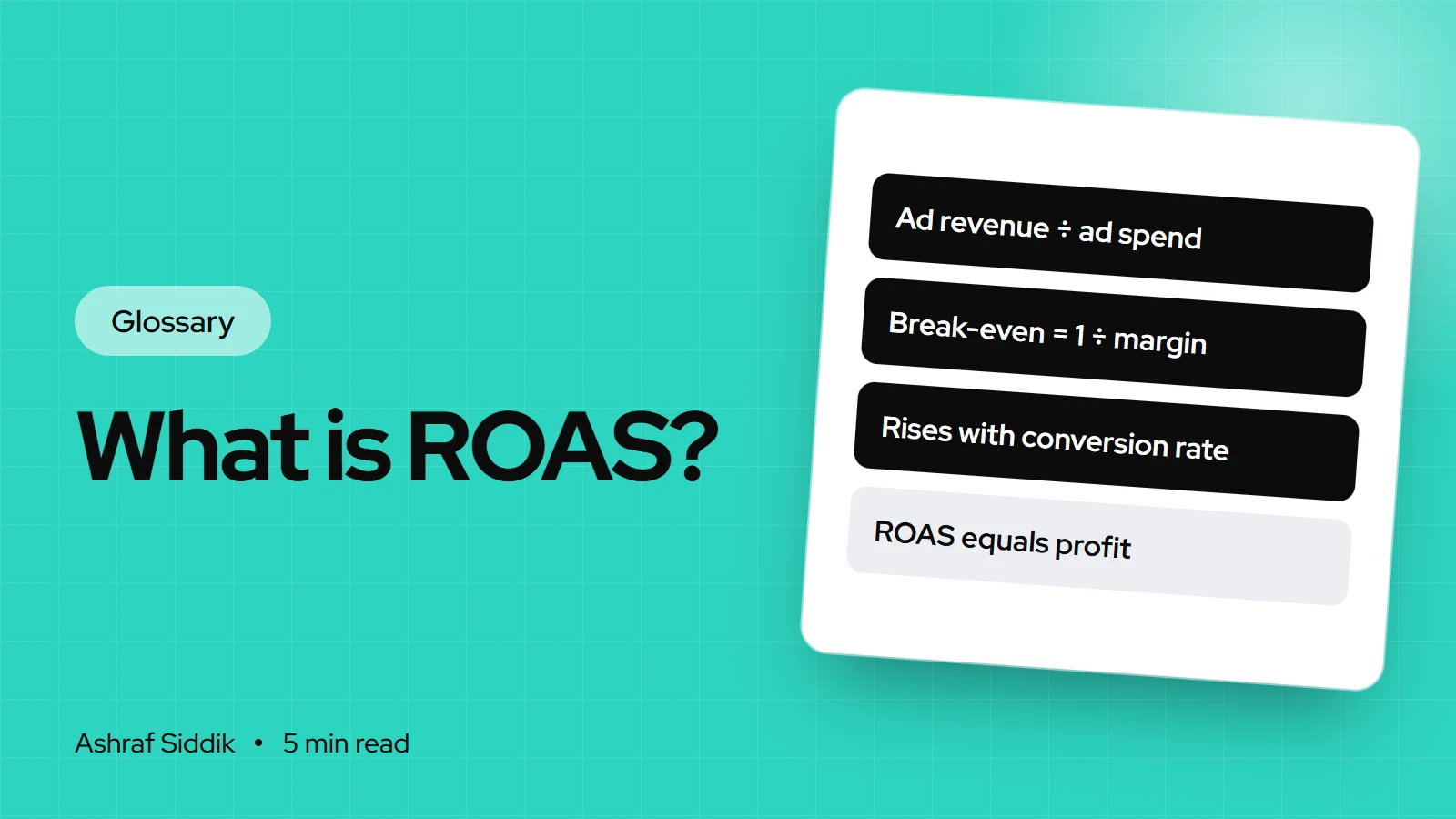
ROAS (return on ad spend) is the revenue your ads bring in for each $1 you spend on them. The ROAS formula is ad revenue ÷ ad spend, so $2,000 in sales from $500 of ads is a ROAS of 4, often written as 4:1, 4x or 400%.
Google expresses it as a percentage in its Target ROAS bidding: $5 in sales ÷ $1 in ad spend × 100% is a 500% target ROAS. In Google Ads reports the same ratio appears as conversion value per cost, and Meta reports purchase ROAS. I don't manage ad accounts. I work on the store those ads send people to, and that store has a bigger say in your ROAS than most people expect. Definitions were checked on Google, Meta and Shopify's help pages on 7 November 2026.
The ROAS formula
ROAS = revenue from ads ÷ ad spend
For a percentage, multiply by 100. Google's own tip for setting a Target ROAS is to take your historical conversion value per cost and multiply it by 100.
To know whether a ROAS is any good, work out your break-even point first:
Break-even ROAS = 1 ÷ gross margin
Break-even ROAS at a 40% gross margin
- Break-even ROAS2.51 ÷ 0.40. Below this, ads lose money on product costs alone.
- Gross profit at ROAS 4$0.60Per $1 of ad spend: $4 revenue × 40% margin, minus the $1.
A worked example
These numbers are illustrative. A store spends $750 on ads and gets 1,000 clicks at $0.75 each. Average order value is $60. Only the store's conversion rate changes.
| Conversion rate | Orders | Revenue | ROAS |
|---|---|---|---|
| 2% | 20 | $1,200 | 1.6 |
| 3% | 30 | $1,800 | 2.4 |
| 4% | 40 | $2,400 | 3.2 |
Same ads, same budget, same clicks. At a 40% margin the store loses money at 2% and 3% conversion, and makes money at 4%. That is the CRO case for paid traffic in one table.
Where to find ROAS for a Shopify store
- Shopify: go to
Analytics > Reports > Performance by marketing channel. It shows ad spend and ROAS for channels that report cost data to Shopify. It uses the last non-direct click model by default, so its numbers won't match the ad platforms. - Google Ads: add the Conv. value / cost column. It only works if your purchase conversions pass a value.
- Meta Ads Manager: purchase ROAS, based on purchases Meta attributes to your ads.
- GA4: useful for a cross-channel view of revenue by source, with GA4's own attribution settings.
Common misconceptions
- "ROAS is profit." It isn't. A ROAS of 3 on a 25% margin product loses money. Profit on ad spend fixes this by using gross profit instead of revenue.
- Adding up platform ROAS. Meta and Google can both claim the same order inside their attribution windows. Your Shopify sales are the reality check.
- Inconsistent revenue. Check whether your conversion value includes tax and shipping, and keep it the same everywhere.
- Trusting high ROAS on brand and retargeting. Some of those buyers would have ordered anyway.
A simple test of platform claims: pause a small campaign for two weeks and watch total Shopify sales. If sales barely move, much of that campaign's reported ROAS was credit for orders you would have got anyway.
Related terms
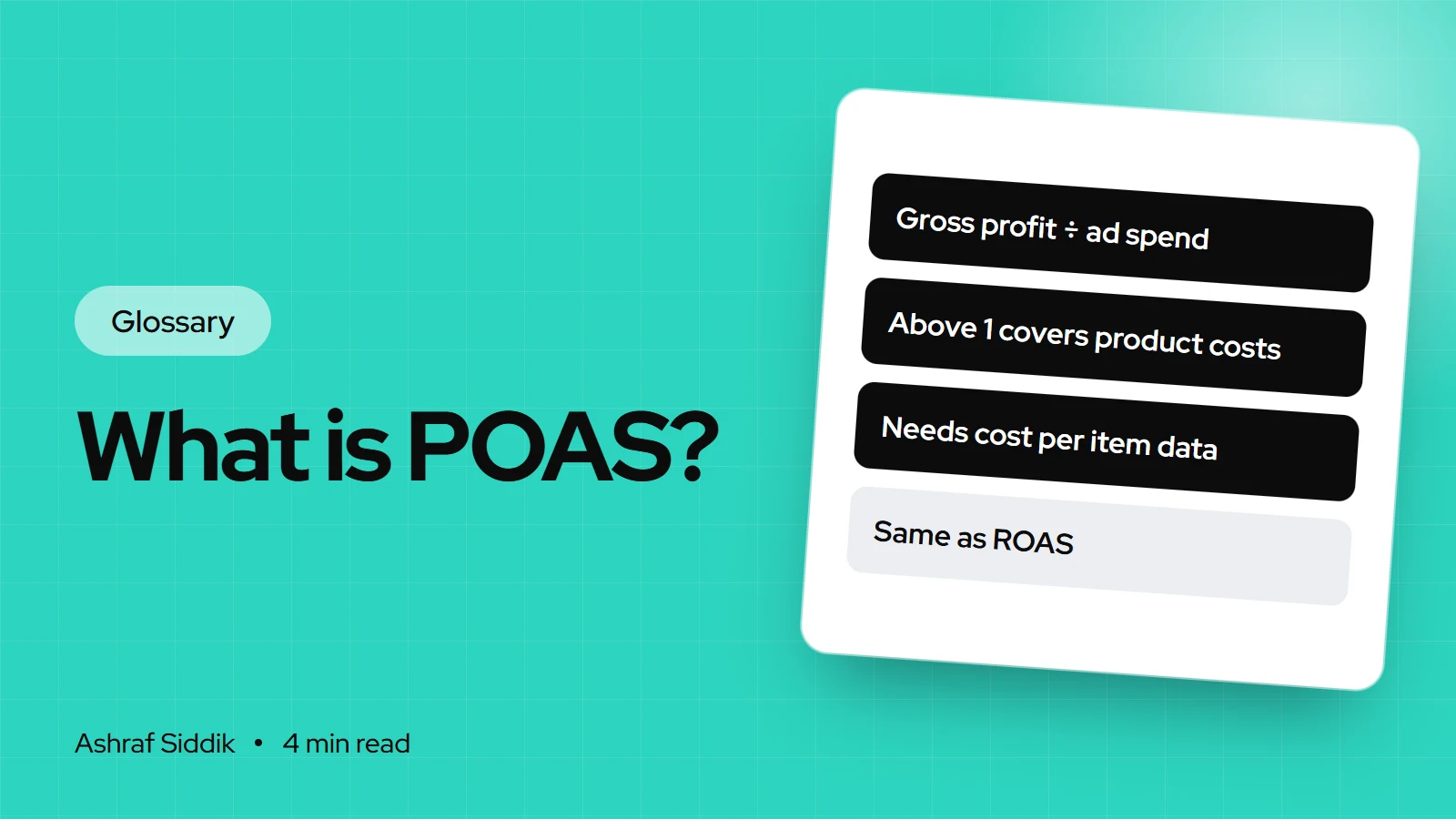
- POAS (profit on ad spend): gross profit ÷ ad spend, the profit-based version of ROAS.
- Customer lifetime value: what a customer is worth over time, which can justify a lower first-order ROAS.
- MER (marketing efficiency ratio): total store revenue ÷ total marketing spend.
What to do next
- Find your break-even ROAS. The profit margin calculator gives you the margin to plug in.
- Compare platform ROAS with Shopify's report for the same 30 days, and note the gap.
- Raise conversion rate on your paid landing pages. My Shopify CRO work starts from $500, and every project begins with a free store review.
Free tools
Check your own store
Free, no sign-up. Each one runs a part of this guide for you.
Frequently asked questions
What is the ROAS formula?
ROAS equals revenue from ads divided by ad spend. If $800 of ads brings in $3,200 in sales, ROAS is 4, which can also be written as 4:1 or 400%.
What is a good ROAS?
A good ROAS is one above your break-even point, which is 1 divided by your gross margin. With a 50% margin you need a ROAS above 2 to make money after product costs. There is no official benchmark that fits every store.
What does a ROAS of 3 mean?
It means every $1 spent on ads brought in $3 of attributed revenue. Whether that is profitable depends on your margin: at a 40% margin it leaves $0.20 of gross profit per $1 spent, before shipping and fees.
Why does Shopify show a different ROAS from Meta or Google?
Each tool uses its own attribution. Shopify's marketing reports default to last non-direct click, while ad platforms credit purchases within their own click and view windows. The same order can be counted by more than one platform.
What is the difference between ROAS and ROI?
ROAS compares revenue with ad spend only. ROI compares profit with the total investment, so it accounts for product costs and other expenses. A campaign can have a healthy ROAS and a negative ROI.
How can I improve ROAS without changing my ads?
Raise your store's conversion rate and average order value. With the same clicks, more orders or bigger orders mean more revenue for the same spend, which lifts ROAS directly.
Sources
- About Target ROAS bidding, Google Ads Help
- Conversion value per cost: Definition, Google Ads Help
- Ad Account, Insights, Meta for Developers
- Marketing reports, Shopify Help Center
Related services and work

I'm a Shopify developer and CRO specialist. I have built and improved Shopify stores since 2018, completed more than 1,000 projects, and hold a 4.96 average rating across 719 client reviews.
More guides
-
What Is POAS (Profit on Ad Spend)? Formula and How It Differs from ROAS
POAS measures the gross profit your ads bring in for each $1 of ad spend. Here is the formula, why it can tell a different story from ROAS, and how to get the cost data from Shopify.
-
How Much Should a New Shopify Store Spend on Ads?
Spend what you can afford to lose while you learn, sized from your break-even cost per sale. Here's the formula and the store checks to do first.
-
What Is a Good ROAS for a UK Shopify Store?
A good ROAS is one that beats your break-even point, and VAT moves that point more than most UK owners expect. Here's how to work it out.
-
How to Set Up the Facebook (Meta) Pixel on Shopify
The Facebook pixel goes on Shopify through the Facebook & Instagram channel, not your theme code. Here are the steps, the data sharing level to choose and how to test it.