Shopify glossaryGlossary5 min read
What Is DTC (Direct to Consumer)? How Shopify Brands Sell Without Middlemen
Direct to consumer means a brand sells its own products straight to the people who use them, with no wholesaler or retailer in between. Here is what DTC means in practice, where the extra margin goes, and how Shopify brands run it.
Key takeaways
- DTC, or D2C, means a brand or manufacturer sells its own products directly to end customers, usually through its own online store.
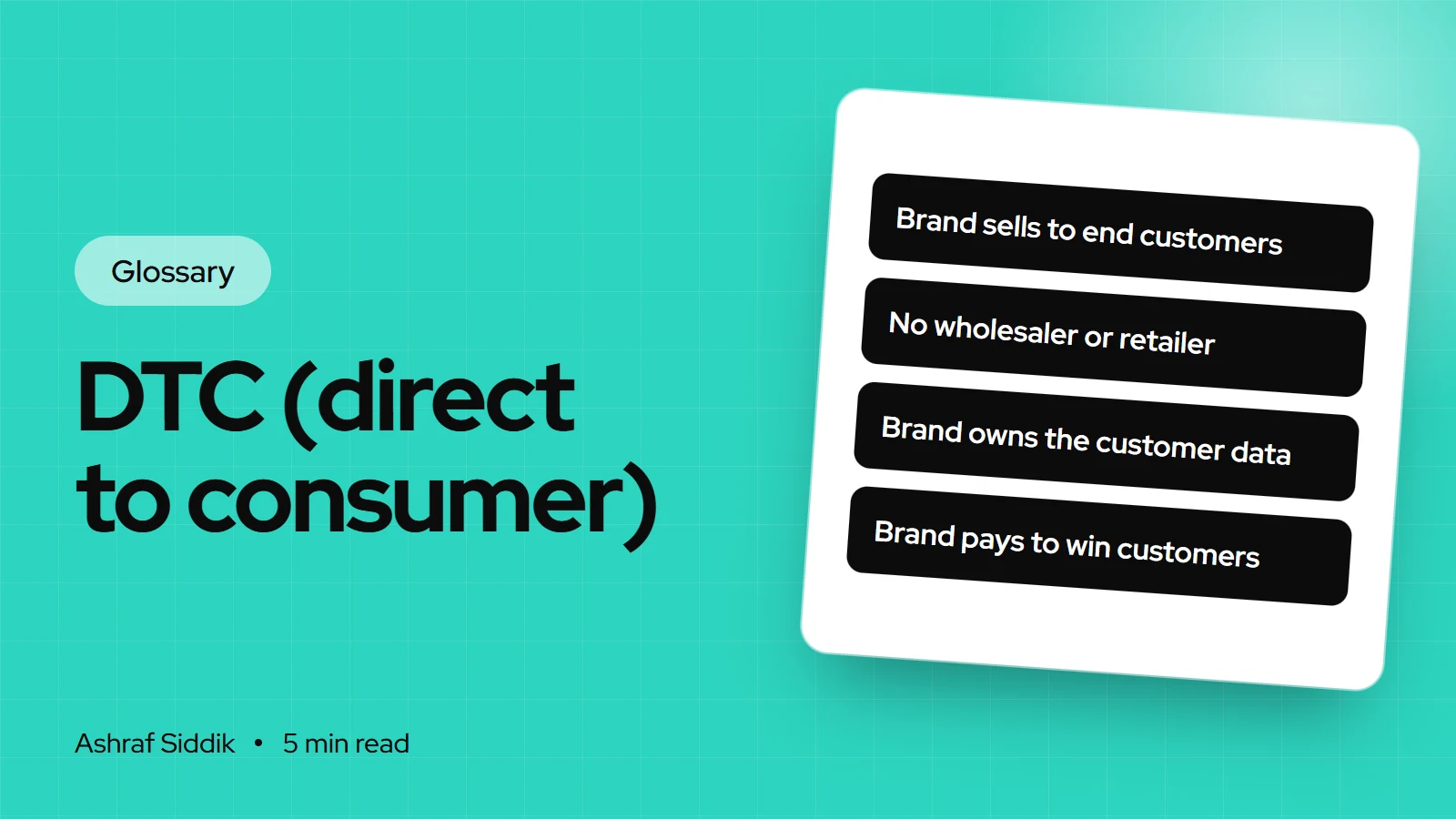
- Cutting out the wholesaler and retailer means the brand keeps the full retail price, the customer data and control of the experience.
- The brand also takes on one-off shipping, returns, customer service and the cost of finding customers, which can eat the extra margin.
- DTC doesn't have to be all or nothing. Many brands sell direct and through retailers or marketplaces at the same time.
- Who it is for
- Brands selling their own products
- Time needed
- 5 minutes to read
- What you need
- Your unit costs and margins
Direct to consumer (DTC) is a business model where a brand sells its own products straight to the people who use them, through its own website, shop or app, instead of through wholesalers, distributors and retailers. Shopify defines it as a brand or manufacturer selling its own products to its end customers.
A direct to consumer brand is simply a brand built around that model. I build and optimize Shopify stores for this kind of brand, and the Shopify details below were checked on 7 November 2026.
How DTC works
The traditional chain runs from manufacturer to wholesaler, to distributor, to retailer, and only then to the customer. Each step takes a share of the price. In the DTC model, the brand reaches the customer through its own marketing and website, and ships the order itself or through a fulfillment partner.
| Aspect | Wholesale and retail | Direct to consumer |
|---|---|---|
| Who sets the price | The retailer | The brand |
| Customer data | Stays with the retailer | Owned by the brand |
| Fulfillment | Bulk shipments to stores | One parcel per order |
| Returns | Handled by the retailer | Handled by the brand |
| Finding customers | Retailer's footfall and reach | Brand's own marketing |
A worked example: where the margin goes
Take a $60 product that costs $15 to make. These figures are illustrative, so swap in your own.
- Through a retailer: say you sell it wholesale at $30. You keep $15 a unit, minus bulk freight, and the retailer finds the customer.
- Direct: you keep $60, then pay $8 to pick, pack and ship, $2.04 in card fees at 2.9% + 30¢, and $15 in marketing to win the sale. That leaves $19.96.
So DTC earns more per unit here, but only because marketing was held at $15 per order. At $25 per order, the DTC sale earns less than the wholesale one. That is why DTC brands care so much about conversion rate and repeat purchases: both lower the marketing cost behind each sale.
Where DTC shows up in Shopify
- Your online store and checkout: the core DTC channel. Shopify runs the storefront, payments and order flow in one admin.
- Customers: every buyer lands on the
Customerspage with their details and order history, and you can group them into customer segments for targeted email. - Customer accounts: customers can save addresses and view their order history with your store, which helps repeat buying.
- Other channels: Shopify POS, social and marketplace channels can run from the same admin, which is where DTC meets omnichannel retail.
Common misconceptions
- DTC means online only. A brand's own physical shop or pop-up is also direct to consumer.
- DTC means no retailers. Shopify's own guide points to Nike as a brand that combines DTC with retail partners. My guide on selling wholesale alongside retail covers running both from Shopify.
- Higher margins are automatic. Shopify notes that leaning too hard on paid ads drives costs up with diminishing returns.
- Retailers won't mind. Selling direct can upset stockists if you undercut them. Some brands avoid this by selling different formats online, such as sample packs or bundles.
- Returns stay low. Shopify's guide says online return rates are usually higher than in physical stores, and in DTC every return is yours to process.
Related terms
- Omnichannel retail: connecting your store, shop and marketplaces into one experience.
- Wholesale: selling in bulk to retailers at a discount.
- First-party data: customer data you collect yourself, a key DTC advantage.
- Customer lifetime value: the total a customer spends with you over time, the number that makes DTC work.
What to do next
- Work out your numbers per order: product cost, fulfillment, fees and marketing cost per sale.
- Fix conversion first. A higher conversion rate lowers the marketing cost behind every order. My Shopify CRO service starts from $500.
- Plan for the second order. Email flows and loyalty matter more in DTC than anywhere else. See how to increase repeat purchases.
- Get a free review of your store if you're moving from wholesale into DTC.
Free tools
Check your own store
Free, no sign-up. Each one runs a part of this guide for you.
Frequently asked questions
What does direct to consumer mean?
Direct to consumer means a brand sells its products straight to the people who use them, usually through its own online store, instead of through wholesalers and retailers. It is often shortened to DTC or D2C.
What is a DTC brand?
A DTC brand is a company built mainly around selling its own products directly to customers. It owns the customer relationship, sets its own prices and handles its own marketing, shipping and returns.
What is the difference between DTC and B2C?
B2C covers any business selling to consumers, including retailers selling other companies' products. DTC is narrower: the brand or manufacturer itself sells its own products to the consumer.
Is DTC more profitable than wholesale?
Per unit it can be, because the brand keeps the full retail price. But the brand also pays for one-off shipping, returns and marketing, so DTC is only more profitable if the cost of winning each customer stays under control.
Can a brand sell both DTC and wholesale?
Yes, and many do. Shopify's own guide points to Nike as an example. Brands often limit channel conflict by offering different products, bundles or formats on their own store.
Sources
- Direct to consumer (DTC): what it is and how it works, Shopify
- Customers, Shopify Help Center
- Omnichannel retail strategy, Shopify
Related services and work

I'm a Shopify developer and CRO specialist. I have built and improved Shopify stores since 2018, completed more than 1,000 projects, and hold a 4.96 average rating across 719 client reviews.
More guides
-
What Is a 3PL? Third-Party Logistics for Shopify Brands Explained
A 3PL is an outside company that stores your stock and picks, packs and ships your orders. Here is what third-party logistics means, how 3PL fees are built, and how a 3PL plugs into a Shopify store.
-
Can I Sell Cosmetics Online in the UK Without Safety Testing?
No. In Great Britain, every cosmetic product needs a safety assessment by a qualified assessor and a notification before you sell it, whether it's made in a lab or your kitchen.
-
Do I Need a Website If I Sell on Etsy or Amazon?
You can sell on Etsy or Amazon without a website. The question is whether you want to keep renting someone else's customers or start building your own.
-
What Is Print on Demand? How It Works with Shopify
Print on demand lets you sell your own designs on T-shirts, mugs and posters without buying stock, because each item is printed after the order. Here is how it works with a Shopify store and what is left after costs.